
- The Crypto market is here to stay, and numbers support the statement, not me.
- Bitcoin and Ethereum still have a lot of space for improvement, at least in terms of efficiency and scalability.
- Among the others, Solana, Algorand and Cardano and their unique protocols approach the future in the most direct way possible.
According to experts, in 2028 the estimated market size of cryptocurrency is going to be $5200 million, which means a yearly growth compound rate of around 29.5%. This means it is a massive industry with rising importance.
For those who have been living under a rock, a cryptocurrency is a virtual currency, without a central entity or authority that regulates it. It uses the blockchain, a technology that is characterized by decentralization among computers to record transactions. It is a peer-to-peer system that allows users to receive and send money all over the world. In this way, cryptocurrencies have multiple advantages such as speed, accessibility, transaction costs, and privacy. However, during the past months, some concerns have been raised regarding some of their characteristics. The main issues identified are scalability1, sustainability2, and decentralization3.
All the crypto assets coped with these aspects differently, and we are going to analyze three interesting cases: Solana, Algorand and Cardano. Just keep in mind that:
- BTC (Bitcoin) processes around 5 tps with gas fees of around 2$ with an energy consumption of 930 kWh/txn4, has 12.000 validation nodes and can take up to 40 minutes to process a transaction.
- ETH (Ethereum) processes 25-100 tps within 5 minutes with gas fees ranging from 10$ up to 100$, consuming 70 kWh/txn and having more than 220,000 validators.
Solana’s current market capitalization is over $30 billion. It is a chain that focuses on efficiency, using innovative protocols like Proof of Stake (PoS) and Proof of History (PoH) allowing it to provide users with high levels of scalability. In fact, Solana can process more than 2500 tps with minimum gas fees and almost immediate speed. Solana is also extremely sustainable, as it uses only 0.166 Wh/txn. This is possible also since Solana does not need a miner to confirm transactions since it relies on users. This increases the energetic efficiency of the blockchain. Solana is not simply a token; it allows the creation of smart contracts ranging from DeFi to NFT.
Another blockchain that is effectively working toward a change in the sector is Algorand, a cryptocurrency created in 2017 by Italian MIT professor Silvio Micali. Its coin named ALGO operates in an ecosystem ruled by Pure Proof of Stake consensus algorithm and byzantine agreement protocol. Algorand’s PPoS protocol selects block validators randomly and secretly for every new block added to the chain. Thus, all users have an equal chance to be chosen by the system. In this way, the network stays fully decentralized and allows the elaboration of 1200 tps (aiming for 3000 tps) with a fee of around 0.0011$. A new transaction is processed in around 4.3 seconds and a block is validated in less than 10 minutes using a byzantine agreement protocol: briefly, a variable random function (VRF) selects the validator through a lottery based on the amount in staking, then the validator proposes the block to the other nodes of the chain in a three-step loop; after every loop, considering at least ⅔ of players to be honest, there is a possibility >⅓ that they agree, so the block is confirmed, but still remain on-chain. This type of agreement is very fast and prevents the formation of forks limiting it to an astonishing 1012 possibility. Regarding sustainability, Algorand needs 0.000008 kWh per transaction and operates on roughly 4000 validators. This demonstrates how efficiency and decentralization can go along, and well.
Finally, there is Cardano and its coin, ADA. Cardano operates on a special Proof of Stake protocol called Ouroboros, which processes transaction blocks by dividing chains into epochs (5 days) and time slots (21,600 per epoch). A slot leader (or staking pool) is selected randomly for each time slot and is delegated and responsible for adding a block to the chain. It receives a reward for validating the block, but a key parameter ensures decentralization by limiting rewards for excessive delegation. This explains why there are more than 3000 active staking pools, but also why it’s scalable and efficient: over 3.3 million ADA accounts and currently can process more than 250 tps at a cost of around 0,34$ each. Sustainability is key also in this blockchain, with a power consumption of around 0.55 KWh per transaction.
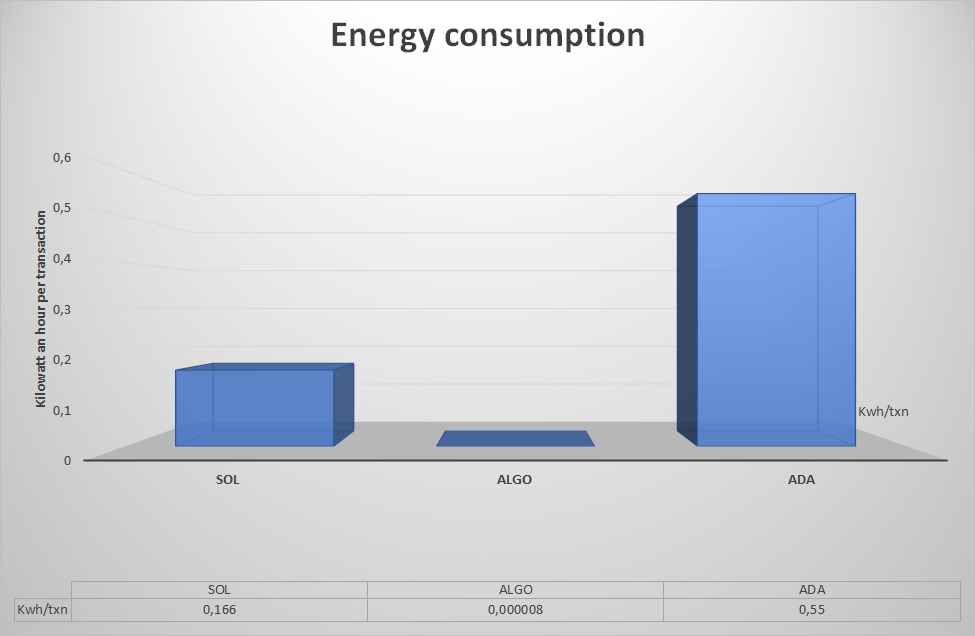
So, what can we learn and expect?
We certainly understood that the crypto markets have sustainability issues and that Bitcoin (for sure) and probably Ethereum are not the way (anymore) to carbon-neutral blockchains. The difficulty when developing blockchains is keeping a balance between scalability, decentralization and sustainability while ensuring the maximum level of security possible. Solana, Algorand and Cardano seem to have found different solutions to the problem. Let’s see how disruptive they can get.
NOTES:
1 Scalability is the ability of crypto to handle a large number of transactions at a time.
2 Sustainability is the energy consumption and carbon footprint.
3 Decentralization refers to the transfer of control and decision-making from a centralized entity to a distributed network
4 Kilowatt an hour per transaction (txn)
5 Transactions per second


 The Bear Street Journal.
Leave a comment