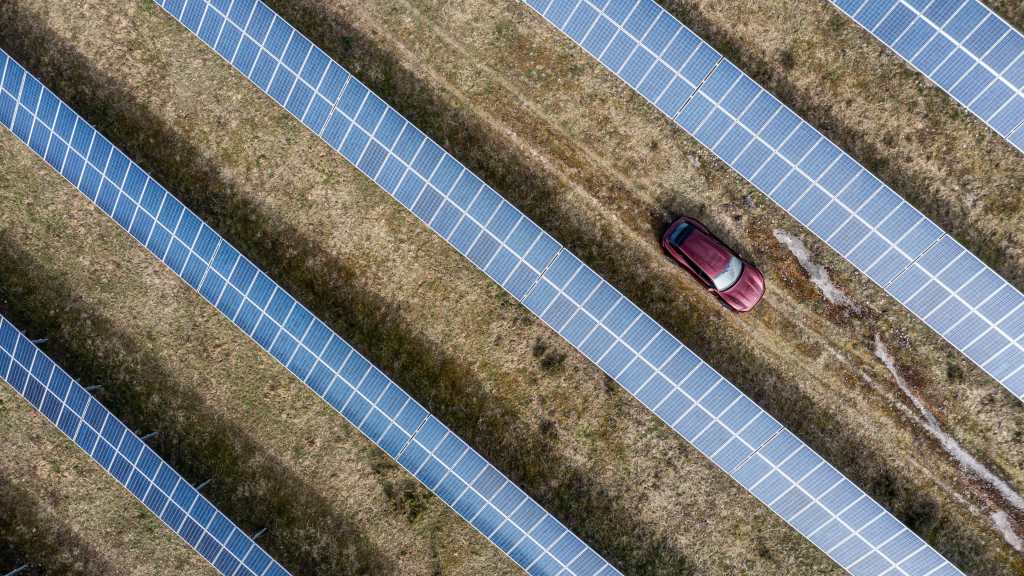
- Among other luxury car companies, Porsche seems to be one of the first to heavily invest in the electric car transition
- With an announcement in 2018, Porsche decided to not produce diesel engines anymore.
- How did Porsche manage to survive the coronavirus pandemic and still invest in connected sectors as a holding?
Everything now must be electric. Of course, the media had little to write about during this first semester of 2022, so it became a trend. To me trends are like inflation: they are in the mouth of everyone but aren’t clear to most. In this scenario, all car industries tend to insert on their website some fashionable graphics with some reports about how they are improving their product with dedication and remarkable passion. But are they taking a step forward to an electric car world or just appeasing stakeholders?
Well, among the several luxury car companies who are converting their production first to hybrid and then to fully electric cars, we find Porsche. The Stuttgart-based company, part of the Volkswagen Group since august 2012, was one of the first brands to enter the market of hybrid in 2010 with the Cayenne S Hybrid and later converted their most selling models like the 918 Spyder, the Panamera and the Boxster. In the meanwhile, they were working on their electric supercar, the Porsche Taycan, whose prototype was presented in 2015 at the Frankfurt Motor Show as “Mission E”. In 2019 it was ready for production, and in 2020 around 20’000 were delivered, representing 7.4% of total Porsche revenues for that year.
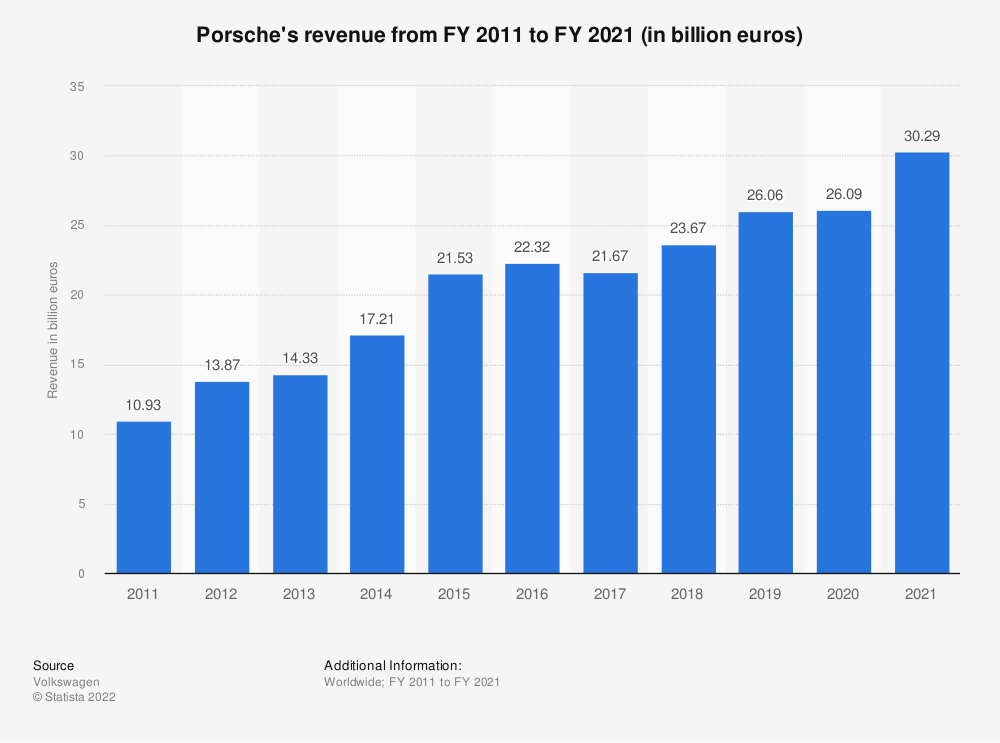
In the end, it all comes down to money, revenues and share prices. As for revenues, Porsche grew strongly between the 2011 and 2021 fiscal years, from just under 11 billion euros in 2011 to some 30 billion euros in 2021. It’s safe to say that the company was able to reap synergies following a manoeuvre of company integration resulting in Porsche becoming Porsche SE, a subsidiary holding of Volkswagen Group in 2012. As of share price, Porsche Automobil Holding SE (PAH3.DE) stock price went from closing at 50.998 € in 2010 to 56.4 € in 2020 and finally to 83.44 € at the end of 2021. In terms of volume the company had its peak on at least 2 occasions over the last 10 years: in 2011, when the volume reached 290.9 million, and in the years 2020-2021, when it respectively reached 155.06 M and 151.25 M. Also, unlike other companies in the automotive industry, Porsche did not suffer the sector crisis during the coronavirus pandemic: in fact, it rose both in revenue and share price.
While I may be not in the position of telling you when and whether you should buy Porsche stocks, I am aware that stock prices could be overpriced, influenced, or speculated. But when it comes to revenue, it’s a good indicator of the company’s health and organic growth, as it can only be misled by faking numbers on financial reports. So how does Porsche manage to change yet still grow?
Porsche bases its financial growth on 2 main drivers: its investment portfolio and the “Mission 2030”, which includes topics like brand perception, sustainability, and attention to employees.
Talking about the investment portfolio, we must first consider that Porsche SE holds most of the ordinary shares in Volkswagen AG as a core investment at 53.3%. It sees itself as a long-term oriented anchor investor: following WW’s intent to become a software-driven mobility provider, to accelerate the transition to e-mobility and autonomous driving, Porsche holds in its portfolio non-controlling interests in technology companies in the USA, Israel, and Germany. The investments of Porsche SE fall into two categories: the first category includes the long-term core investment in Volkswagen AG, while the second category comprises portfolio investments that Porsche SE generally holds for a temporary period, like Isar Aerospace, PTV group (software for traffic management) or INRIX (traffic data). Such investments are characterized by their high potential for growth and for increasing value during the holding period.
As of the strategy, Porsche defined its “Mission 2030”, where it has defined its goals based on the
four stakeholder dimensions of customers, society, employees, and investors. In keeping with this vision, the company aims to be the most recognized brand in the world and one that particularly excites its customers. To achieve that ambitious goal, Porsche will work on improving brand perception and customer excitement. One way they are doing so is by investing in the motorsport industry, taking part to the FIA World Endurance Championship, the Formula E, and the Carrera Cup among others. Museums, Youth programs, track experiences and even sailing yachts complete the circle.
Regarding the important issue of sustainability, Porsche decided, as of February 2018, to no longer include any diesel models in its portfolio. Together with other parts of the WW Group, the company is also actively committed to bringing down nitrogen oxide levels in German cities. Furthermore, the Porsche drive strategy is based on a technology triumvirate: emotive combustion, powerful hybrids and high-performance e-mobility. As such, Porsche reflects the demands and needs of the customers, the environment, and policymakers. This triumvirate is complemented using new technologies available in the market such as eFuels (for example, hydrogen). The company will simultaneously offer vehicles with optimized petrol engines, powerful hybrid drives and all-electric sports cars, with the ultimate goal of having fifty percent of all newly sold cars to be electrified by 2025.
Of course, an electric vehicle causes fewer CO₂ emissions than a comparable vehicle with an internal combustion engine. As renewable energies can be used during an electric vehicle’s service life, one of the biggest levers for reducing the CO₂ footprint can be found in this area. Porsche is accordingly looking to use sustainable energy sources such as wind and solar power. Finally, based on the advantages of e-mobility, Porsche
has decided to adopt a systematic electrification strategy consisting of the creation of an accessible, available charging infrastructure that meets demand and provides a customer-friendly charging process for e-mobility. For this purpose, a network of 350 kW quick-charging stations is being expanded and expedited throughout
Europe with the joint venture IONITY.
Germans indeed know their cars. While being early adopters, successfully increasing revenues and racing at 300 km/h, Porsche is also committed to being the employer of choice, with various initiatives in diversity and inclusion programs, education and sustainability festivals. Just to give an idea, in 2021 the Porsche Group received more than 130,000 applications in response to over 3,800 advertised vacancies. The same year, the sports car manufacturer was ranked as a top employer by students in verified employer rankings. In the Universum Student Survey, Porsche was again named the most attractive employer for engineers in 2021 in Germany and was second for business students. Surprisingly these rankings get worse in Austria and other countries, suggesting the idea that the company works very well close to the main site but worse far from it. How come so and, above all, why Porsche isn’t in Formula One yet? Both huge questions to not sleep for the night.
RESOURCES:
Yahoo Finance
Porsche Newsroom
Porsche Motorsport Hub
Annual Report Fiscal Year 2021 Porsche SE
Annual and Sustainability Report 2021 Porsche AG
https://universumglobal.com/rankings/company/porsche/



 The Bear Street Journal.
Leave a comment