- Many developing non-western countries are creating an alternative economic and political group
- Some nations are leaving behind historical tensions in order to accomplish common goals
- Many more are attracted by the project, but how much will it go further?
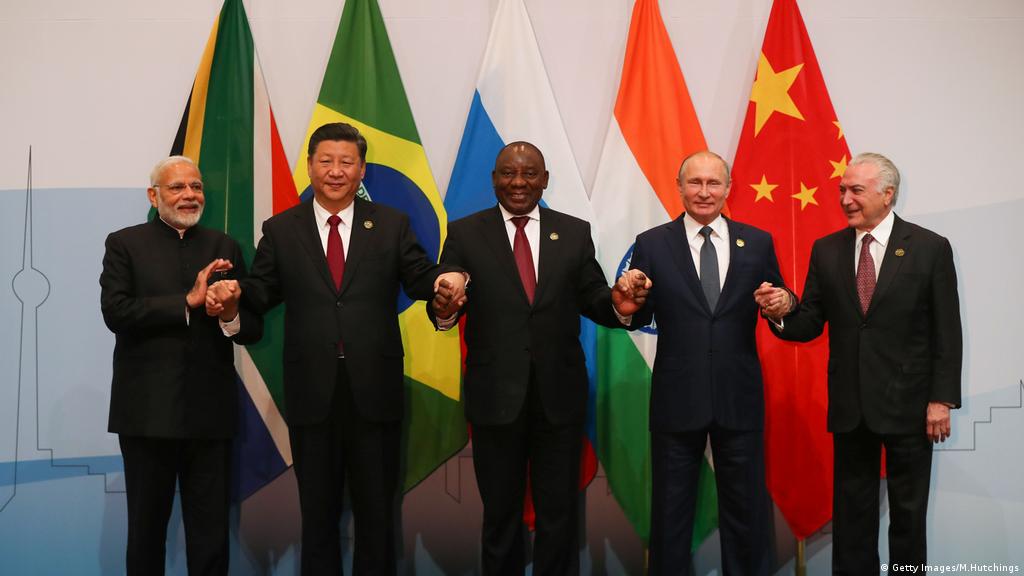
There are a Russian, a Chinese, an Indian, a Brazilian and a South African. It looks like a joke, but actually it’s a video call which took place on 23rd June. These 5 countries compose a new international cluster, the BRICS. The original acronym BRIC (Brazil, Russia, India, China) was invented by the British economist Jim O’Neill to define extended countries with significant natural resources, that experienced GDP growth across the 20th and 21st centuries and oppose the power of the US Dollar in international trade. Ironically, this coincidence became reality in 2009, as the 4 countries created the BRIC alliance, which in 2010 included South Africa too. Every year a meeting is held, where all leaders discuss new financial and economical strategies.
The basis is the axis between Russia and China created around a viewpoint on the world alternative to the American one. Many Occidentals think the Russia-China alliance is obvious, especially for common Marxist roots during the Cold War. However, USSR and China were many times close to conflict, due to the different visions of socialism by Nikita Khrushchev and Mao Zedong. In the 1970s a spiritual crisis divided the communist world into pro-Soviet Union and pro-China countries, as both were interested in a border crisis along the Ussuri river border in 1969. US President Richard Nixon exploited the tensions and started a policy of overture towards the “red China”, which finally led to the PRC’s entry into the international trade net, thanks also to Deng Xiaoping’s innovative idea of market socialism, the same which granted decades of developments. In the 1990s, Russia was a political, economic, and social unstable entity, born from USSR ruins, while deals improved Beijing’s stability, even if China was still inferior to America, which was enjoying the euphoria of the Cold War win and the digital revolution. Both Democrats and Republicans were sure of the primate of America, they were sure they would have had the last say on everything. However, authoritarian leaders such as Vladimir Putin and Xi Jinping united their policies around the idea of redemption against the Washington-consensus world idea. Both share a coercive and vigilant internal policy and an aggressive foreign attitude, usually hidden behind a hypocritical Third-Worldism: they understood that they had to open their arms to new developing countries which haven’t already reached their prime, to find valid allies in their Anti-American project.

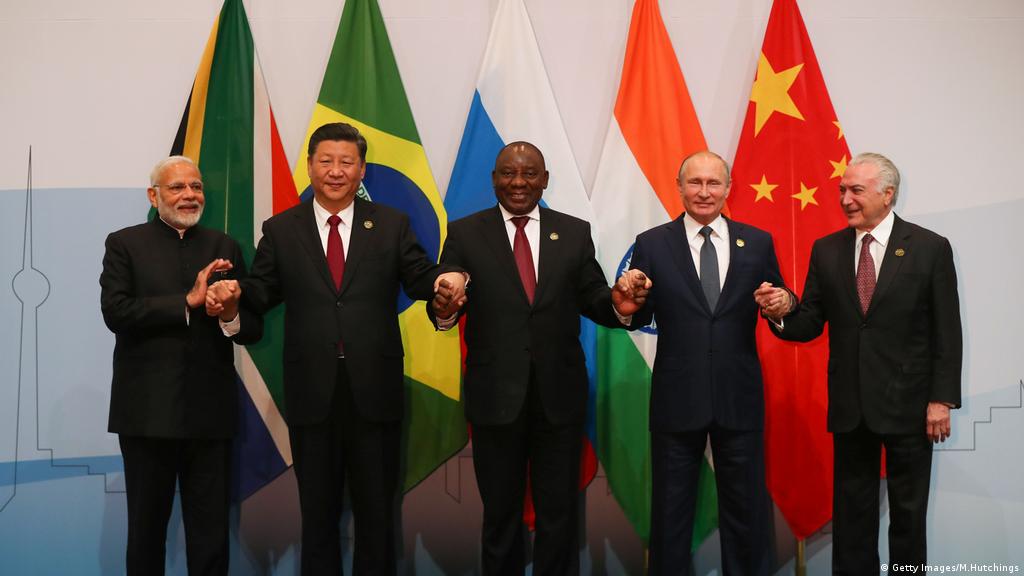
the 5 countries which are part of BRICS acronym (Photo taken from Getty Images)
South Africa is a minor country, but it plays a major role, as thousands of gold mines are located here and they could be a new resource for Russian treasure, which is losing all its foreign currency reserves. The African country was a loyal ally of the US during the Apartheid regime, as all socialist parties became illegal. SA sustained Portugal’s efforts to maintain its colonial territories and intervened directly in the Angolan civil war against socialist groups, backed by Cuban and Soviet divisions and councilors. After the end of racial segregation, South Africa held a neutral position, maintaining relationships with the Western world, but creating new ties with India and China: that’s also because the “Rainbow nation” hosts vast Indian and Chinese communities, especially in cities like Durban, Port Elizabeth, and Johannesburg, even though they are experiencing an intolerant climate, as they are seen, like Whites, as exploiters who caused the economic inequality which is tearing the country apart.
Another historical ally of the USA is Brazil. Despite not condemning the Ukrainian invasion and depending on Russian fertilizers for his agricultural and farming economy, Jair Bolsonaro is a trustful figure for the American lobbies. His electorate is composed of groups culturally near to the United States, such as evangelical churches, entrepreneurs, and neo-liberal intellectuals. He showed himself as a close friend of Donald Trump, backing the creation of a free-trade zone across the two Americas and opposing the Chinese trading expansion (Bolsonaro blocked the development of a 5G system and criticized Sinovac importation by Sao Paulo State), but regardless deep cultural differences with Joe Biden, he shares the same view on socialist realities like Cuba or Venezuela and both armies trained together in different occasions. However, Bolsonaro’s agenda risks running out soon: in October elections will be held and the favorite is Lula da Silva, former socialist President, which has been acquitted of corruption. If he won, he could reinvigorate ties with Russia and introduce Brazil into the club of China client states.
Anyway, the real enigma is the Delhi position. Amazon CEO Jeff Bezos predicted the 21st century to be the Indian century and suggested the USA keep a solid partnership with India. Beijing and Delhi have been hardcore enemies for 60 years, as China backed Pakistan’s claims on Kashmir against India, which ended in a border war in 1962. In 2020 new border tensions exploded in disputed Himalayan highlands, while PM Modi implemented Hindu nationalist Anti-Chinese policies, supporting Taiwan and Tibet independence movements and taking part in the QUAD (Naval alliance between the USA, India, Japan, and Australia which aims to contain China presence in Indo-Pacific zone). In appearance, it would seem that India is the perfect ally for the United States. Unfortunately, the Indian government has revealed itself as one of the most indulgent toward Russian aggression. That’s because India has longtime relationships with Moscow. Former USSR launched space and technological shared operations with the Indian government, using Delhi as a proxy against China (still in the context of philosophical war between China and the Soviet Union) and nowadays Russia supplies the Indian army with guns and new technological devices. Moreover, Hindu chauvinism includes strong hate against Westerners due to colonial domination roots, so a true and trustful alliance with USA and NATO appears today very difficult.
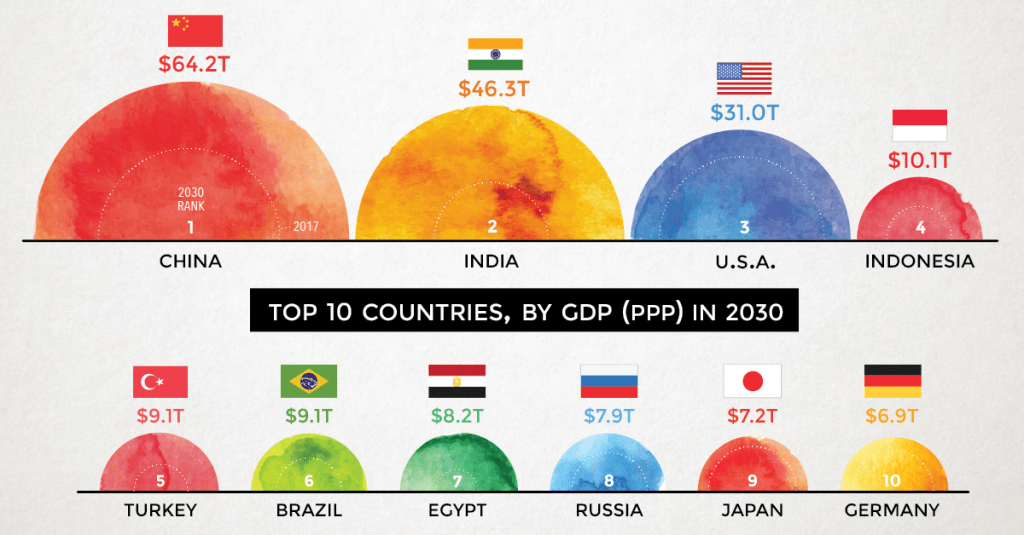
Chart predicting PPA GDP ranking in 2030 (Standard Charted data, graphic developed by Visualcapitalist.com)
Americans are worried that the single pole world which was taking shape in 1991 is going to disappear. The real question is about future developments, and if the situation will be more complicated than how it is today. Actually, we are pretty sure that other countries will demand to be admitted to the BRICS club. Many may fit perfectly, as they are key Russia and China allies or sympathizers, for example, Iran or Argentina (assuming filo-Western parties won’t win the 2023 elections and Bolsonaro, a declared enemy of the left-wing Argentinian government, will be no more president), others will be a sort of elephant in the room: that’s the case of Turkey and Saudi Arabia, which are still officially at least US allies, and enemy of Iran, a potential candidate. Many projects are on the table of BRICS meetings. The first is the creation of an International Bank for economic development, external to the World Bank and IMF and many think the 5 nations will create a new international currency, which will challenge the USD in international trade and finance. 2030 will be, according to Standard Charted Bank, the year in which the USA will be overtaken by both China and India in terms of GDP. New countries such as Brazil, Turkey, Indonesia, and Egypt will be just behind the three top economies, while UK, Germany, France, and Italy will slip down in this ranking.
Apart from every prediction, a tangible trend has been detected: the historical American-ruled world is going to be the past. Western countries are living an economic stall, besides cultural and demographic oblivion, while non-Western countries are experiencing astonishing birth rates and immense economic potentialities. We don’t know if America and Europe will be flattened, but for sure we are seeing the definitive creation of a multipolar world. Is it good or is it bad? That’s up to your personal opinion, but this trend is irreversible.
Sources:
https://www.businessinsider.com/jim-oneill-presents-the-mint-economies-2013-11?r=US&IR=T
https://www.wsj.com/articles/putin-and-xis-bet-on-the-global-south-11657897521
Cina e India: relazioni pericolose
Argentina e Iran chiedono di entrare nei BRICS
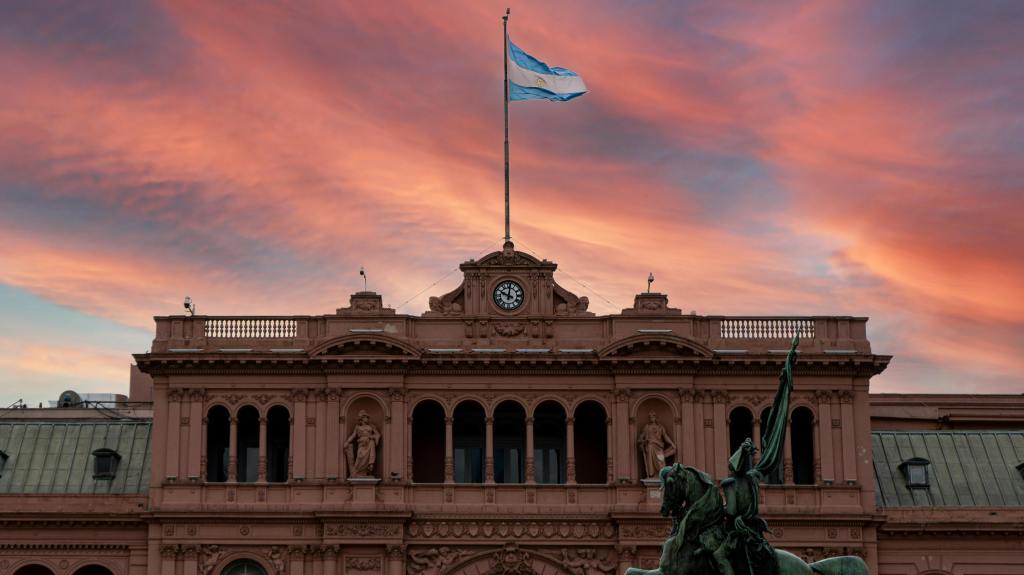
Front page photo taken from Getty Images


 The Bear Street Journal.
Leave a comment