- The USD has gained a substantial amount of value compared to major currencies during the last months
- With wars and supply shortages, inflation is on everybody’s mouth
- Interesting comparisons come to life when referring to the legendary 1970s US inflation
This is not the right summer to go on an East Coast camper road trip from Miami to New York. Nor Los Angeles to Chicago. Or pretty much everywhere in the United States, as converting euros nowadays makes you want to ask your employee to pay you in dollars instead. We have to accept it, in this particular time frame euro is no longer that strong of a currency, at least when compared to the dollar. Why is that?
My answer will be brief: the dollar is more appealing to investors because of higher interest rates and because it’s considered a safe haven: while holidays and imports are cheaper for Americans (and the US are an importing country), some countries like Sri Lanka, Argentina and Chile that are no longer able to repay dollar-denominated debt. Though, this is a natural effect of a strong appreciation of a currency against the others in a variable pair system but can affect US industries that base their strategy on globalization (let’s think for example at 1Apple and its distribution system of producers) since exports are damaged by the high costs of imports from abroad.
The rise in interest rates has been a direct consequence of the latest events happening around the world. In particular, the first half of the year 2022 has been very tough on the global economy and state institutions. The outbreak of the war in Ukraine in late February certainly influenced natural resources costs, such as natural gas and corn, and exposed the major commercial routes passing through Ukrainian territories. In addition to the fact that there is a war in Europe (that quite shocked me), the shortages of almost every type of commodity raised the prices of materials: then the final products and goods increased in price. Going straight to the point: inflation. The most impacted sector of all has certainly been the energy sector, whose inflation rate in June 2022 has been around 42% just in the EU, while the sector of transport and food is well over 10% (16% and 8.9% respectively). In the US they have even big problems as well, with energy costs rising from 34.6% to 41.6% in June 2022 and with the food sector at over 10%. Overall, the annual inflation rate in EU is at 9.6%, while in the US is about 9.1%, as of June 2022. These numbers are the highest ever registered since November 1981 (US) and 1982 in Europe.
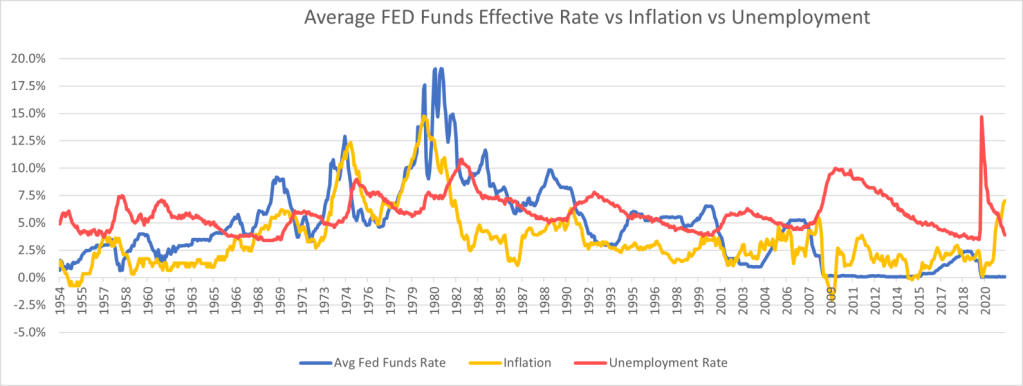
It’s funny how in late 1981 US inflation was on a downtrend. The infamous 1970s US inflation or “stagflation” as economists refer to it, was a period in which both inflation and unemployment rates rose. It all started with the increase in military spending encouraged by President Johnson’s Great Society programs in the years 1964-65 and became unsustainable under President Nixon’s mandate in 1971. That year the US decided to abolish the gold standard and the Fed didn’t raise interest rates but just increased the money supply. In the following years, economy was shocked again due to the loss of the Vietnam war and the first petroleum crisis of 1973, caused by shortages and delays due to the Kippur War (October 1973), when OPEC countries (Organization of the Petroleum Exporting Countries) military backed up Egypt and Syria’s attack on Israel. Since the US, as well as many European countries were pro-Israel, an embargo was imposed on them. Just to give an idea of how all these factors combined in rising inflation, in 1974 the annual inflation rate was at 11.05% and in 1980 it was at 13.55%. While economists tend to agree that a 2% rate is good for the economy, they would have had quite a reaction when a rate that low was never achieved between 1966 and 1985. Anyway, it was not until the beginning of the 1980s when Fed president Paul Volcker began aggressively to raise interest rates and, after initial difficulties, inflation was under control.
Some similarities can be found between today’s inflation and the 1970s one, apart from the prayers of the population:
- Both trends started because of an increase in some government costs, military and oil then and natural resources now.
- Both trends started and persisted over a period of geopolitical instability (Vietnam and Kippur then and Ukraine now)
- Both trends have seen at some point an increase in interest rates that provoked recessions then and near recessions now.
That’s pretty much it. In fact, according to Brandeis Business School professor S. Cecchetti “Today’s inflation and the threat we have is actually like the last half of the 1960s. (…) In the mid-1960s inflation had been running about 2%: by the end of the 1960s inflation went to about 5%. The last inflation reading we had was still below 5% and so you’re nowhere near 20%, which was the highest inflation reading at the end of the 1970s. There’s almost no period in the 70s that had its inflation as low as we have now”. In addition, inflation seems to be expected after a period of economic growth as we experienced over last year: “Some of the recent spikes in inflation are a very healthy sign of the recovery” told MIT professor A. Orphanides to the Wall Street Journal.
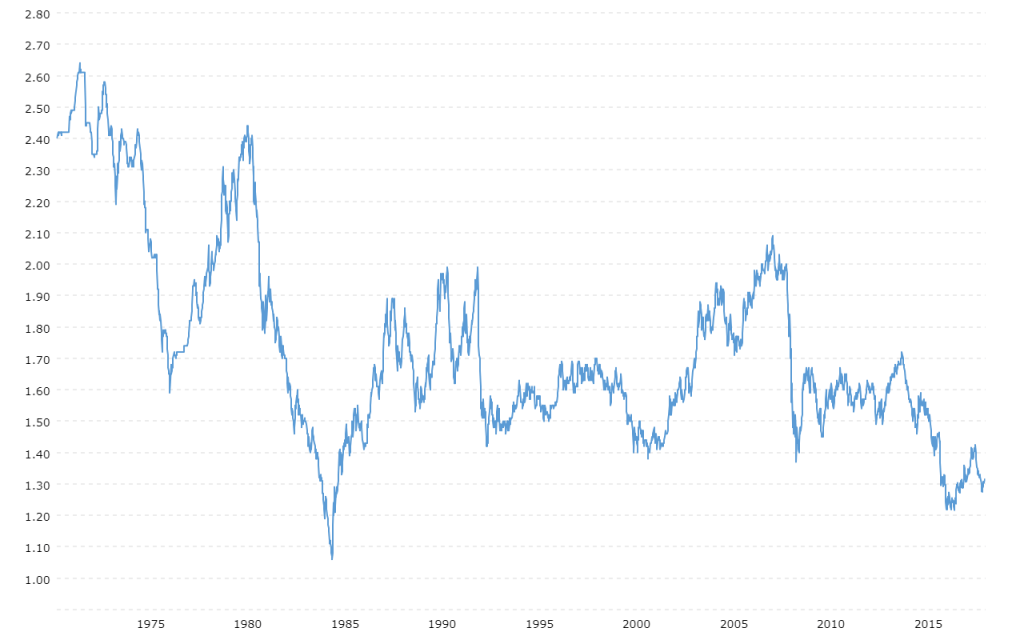
To summarize, the dollar is strong because the Fed confronted inflation rising interest rates more than other countries’ central banks. Generally speaking, the Federal Reserve tends to keep the fed funds rate within a 2.0% to 5.0% sweet spot that helps maintain a healthy economy, but there have been exceptions, like particular high inflation or to stimulate economic growth (2020). As of now, Fed interest rates have come back to the pre-pandemic levels around 2.5% from 0.5% in April 2022. In the meanwhile, Bank of England raised its rates to 1.25%, the highest since the 2008 housing bubble. The ECB raised its 3 key interest rates by 50bps during its July 2022 meeting, the first increase since 2011, ending eight years of negative rates, in an attempt to release the inflationary pressures. The main refinancing rate is now at 0.5%. As a result, during the first half of 2022 USD value rose by 16.64% in a year compared to EUR and +14.69% up on the GBP. When comparing these data to the recovery period after the great inflation of the 1970s, we discover that the USD gained a whopping 83.41% over the EUR* and 101% over GBP from 1980 to 1985. At the time there was no European Central Bank, but interest rates in the UK were on the 5-year average at about 12.3%; US interest rates were on average lower (11.56%) but registered an overall peak of 20% in 1980. Today’s numbers don’t seem so impressive anymore. Of course, every crisis is different, how historians say “every event tends to reoccur later” so take this data carefully. If there is one thing that we can agree is that we found out another reason why people in the 70s were going crazy on every drug: it was to forget how the economy was going.
*The comparison is between USD and ECU (European Currency Unit) since it was a unit of account used by the European Economic Community and composed of a basket of member country currencies. The ECU came into operation on 13 March 1979 and was replaced by Euro on 1st January 1999.
Image courtesy of Pexels
RESOURCES:
- https://ec.europa.eu/eurostat/statistics-explained/index.php?title=File:Euro_area_annual_inflation_and_its_main_components,_June_2012_-_June_2022.png
- https://www.usinflationcalculator.com/inflation/current-inflation-rates/
- https://tradingeconomics.com/euro-area/interest-rate
- https://www.macrotrends.net/countries/USA/united-states/inflation-rate-cpi
- https://www.wsj.com/articles/why-7-inflation-today-is-far-different-than-in-1982-11642012166
- https://www.wsj.com/articles/europe-is-tested-anew-this-time-by-energy-inflation-and-putin-11658506756
- https://www.businessinsider.com/personal-finance/causes-of-inflation?r=US&IR=T


 The Bear Street Journal.

Leave a comment