
- The NFL just signed an annual 10 billion $ contract for TV rights
- An entire country stops during the Super Bowl to see a football mid-air
- Highest revenues, loads of engagement, what can go wrong?
Have you ever heard of the Super Bowl? It’s the final game of the National Football League, taking place in different cities around the United States every February. Well, to be fair, it’s way more than a simple -yet difficult to understand- football game: the whole US is frozen for the day, with millions of Americans (actually, over 100 million, more or less a third of the total population) sitting on the sofa with a beer in the right hand and chicken wings in the left one. A 30-second ad during the event cost around 6 million dollars, while around 70,000 spectators paid at least 4,000 $ in tickets each during Super Bowl 56 in Los Angeles on 14th February 2022. It’s way more than a single game, it’s a straight business.
In fact, the NFL season is way more than the SB: it generally starts all the way back to the middle of March, when clubs must exercise options on players with option clauses and/or expiring contracts. Then at the end of April, the draft takes place and teams begin to select their rookie players for the upcoming season. After that a long summer of rookie camps and all sorts of pre-season training camps, along with Hall of Fame weekend and a game (a game played between important retired players). In the middle of August, pre-season starts for a total of 4 weekends till NFL kick-off around the half of September. Each of the 32 teams plays 17 games over 18 weeks. The best teams from every division qualify for the playoffs, which take place during January and end with the Super Bowl. All clear? Now let’s go to the financial side.
In 2021 the most valued franchises in the league, the Dallas Cowboys and the New England Patriots were valued at 6.5 billion and 5 billion dollars each. All the other teams were valued at at least 2.2 billion $ and overall revenues ranged from 340 to 800 million $. To have an overview, the most valued football club in England in 2021 was Manchester United, with a value of 3.47 billion pounds (4.22 billion $) while the least valued team, Sheffield United, was worth only 45 million pounds (54.8 million $). In the meanwhile, the most valued team in the NBA in 2020 was the New York Knicks at 6.1 billion $ and the least worth one was the New Orleans Pelicans with 1.51 billion $.
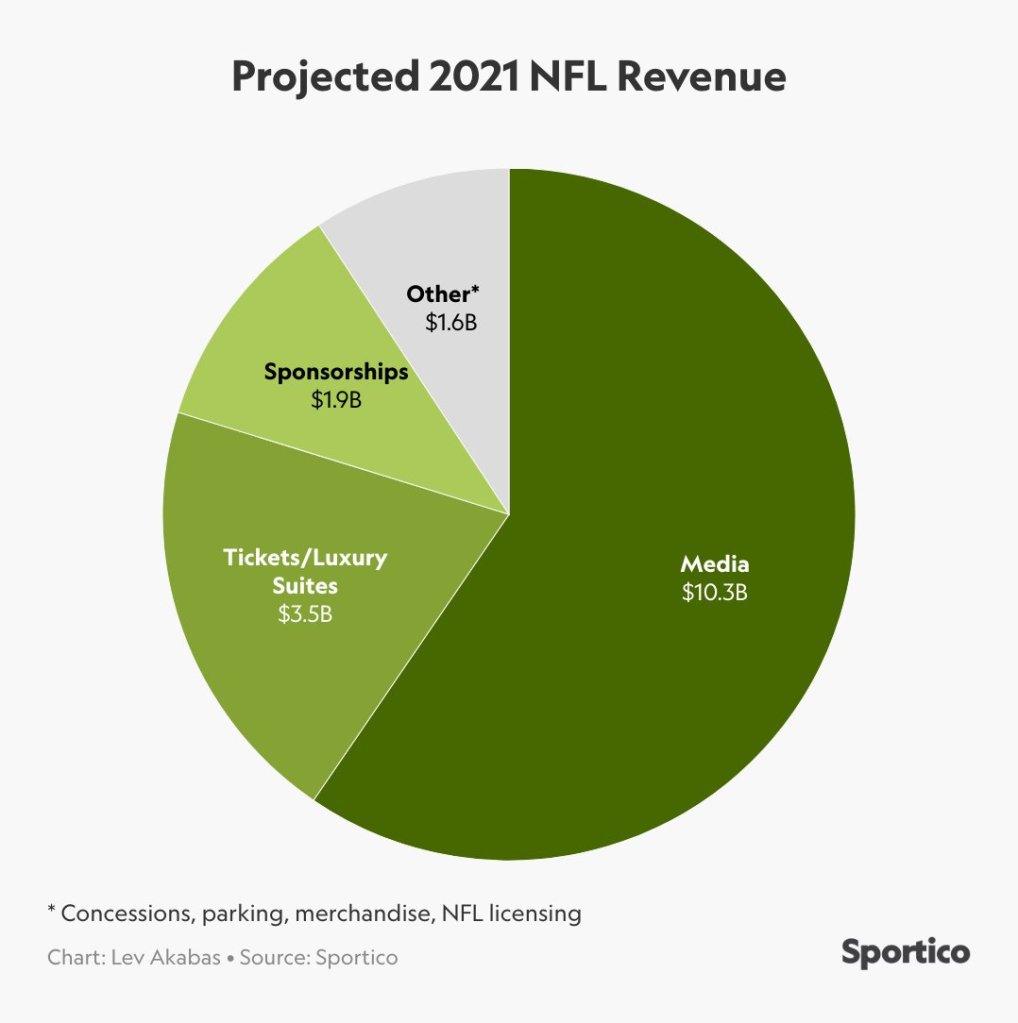
A huge factor in the revenues of the NFL is TV contracts and sponsorships. Generally speaking, a media company is willing to pay as long as it is convenient for them. In 2021 the NFL announced the contracts for the upcoming years, with games divided between Amazon, CBS, ESPN, FOX and NBC for a total of around 10 billion $ per season. In the meanwhile, the NBA expects to renew its Tv contracts for the 2025-26 season for a total of 8 billion $, and the EPL is expected to gain around 13.5 billion $ for the 2022-25 cycle (so let’s assume every year to be worth around 6.75 billion $). If we take these numbers and compare them to the number of total games played including play-offs and international cups*, we notice that NFL earns per game 36.7 million $, the NBA 6.13 million $ and the EPL 16 million. Why do companies pay that much? Well, because football is very popular: according to CNN, during the 2021 season 17.1 million people on average were watching NFL games, while the NBA averaged on ABC 3.3 million viewers (to be fair, the average from ESPN and TNT of 1.4 million is excluded) and the EPL on NBC averaged “only” over 400,000 viewers. *Since the length of the NBA and the EPL is not variable, there has been made an approximation of 75 games total in the NBA playoffs and 40 games total in international cups and the FA cup.
The question rises spontaneously: how did the NFL manage to be worth more than the English Premier League and the NBA even though there are only 17 games a year? Why the games are so few compared to the 38 of the EPL and the 82 of the NBA? Well, even though basketball and soccer players don’t tackle each other on every play, there is not really a physical reason why the NFL could not play games more regularly, rather, the way they have built up their brand, and their infrastructure, to maintain the relative scarcity of their games. It is no coincidence that the once-a-week, 16-game schedule league has every single game broadcast on TV, not by home team announcers, but by national, professional broadcasters. It’s no coincidence that many of the teams in the NFL can rather easily fill a 70,000-seat arena. They have built their brands around the once-a-week event and adding any more games (especially a second game a week) would only serve to dilute the brand and infrastructure that they have built. In fact, is all about scarcity, a thing that especially seems to be unknown to the high ministers of UEFA (European football organization), since games in EPL are played each time at different hours if not on different days, with international competitions during some days of the week and some random stops to let the national teams play. Having clear days and times allow the fans to create an experience and to follow their team with way more simplicity. Fans are more engaged and look forward to next week’s game as it was the release of a new episode of a sitcom. This is all part of the NFL mission consisting of “bringing fans and communities from all walks of life together to celebrate a game that is constantly evolving, balancing the authenticity of tradition with the power of innovation.”
Furthermore, the previous data not only is astonishing in terms of the views per game or the revenues but because the NFL is among them the most local sport. Don’t get me wrong, but NFL is part of the US culture and is famous also because it carried on a tradition. A very well-designed marketing technique for sure, but the world is wider. While soccer is way more popular across the world, the EPL is now the most famous soccer league of all, getting almost half of its revenues from outside the UK. On the other hand, basketball is very popular in Europe (Euroleague) and in recent years the NBA made it clear that it intends to expand its horizons toward China, Central America, South Africa and Europe. The NFL is the last in this picture. The Super Bowl certainly attracts a lot of international viewers, but for the majority because it is a major show, with halftime concerts and celebrities. Because of that, the league has been expanding its fan base with the International Series, a program running since 2007 that allows some regular-season games to be played outside the US. The preferred destination is London but in the last year games have been played also in Mexico City and in München. There is still a long way to become international, but the first steps have been made.
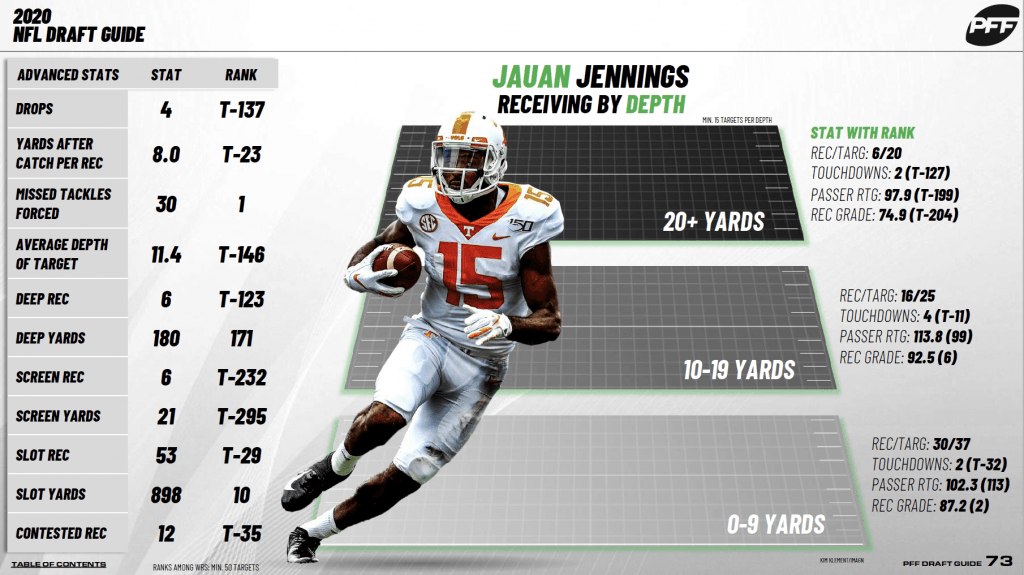
Instead, NFL seems to be focusing a lot on engagement: connecting with fans elevates the simple game to a style of life. Focusing on the younger generations, way more demanding than the older ones, in the last years the league started partnering with various internet-based companies: via Yahoo, the league live-streamed the 2015 season; additionally, live streams were also made available on NFL Mobile, Network Watch App, NFL Now, and NFL Game Pass. All these technological investments come along the way to digital transition. Pregame shows, technical analysis, advanced statistics, latest issues are on everybody’s device at every given time. But that is not it: collaboration with EA sports successfully lead to the release of the “Madden NFL” video game series, updated every year with online multiplayer features, career mode and many more, adapted to the most popular consoles (like PlayStation by Sony) and mobile (with the “Overdrive” series). A lot of effort has been put in support of Fantasy Football, a game in which friends choose their roster and play against each other, with points and bonuses given on the base of real game results and player performances. All this ecosystem is beneficial for the league also because it’s a very powerful marketing tool, making football a social activity even for people who have never even touched a football. Not to mention that is the main way for people outside the US to experience the NFL.
It’s probably because I am into finance and business strategy, but the focus on scarcity really appeals to me. The NFL teaches us at least two things: that a well-engaged niche is way more valuable than a general fan base and that apparently it’s not important if people understand the game, as long as there is Snoop Dogg singing during the halftime show.
RESOURCES:
- https://creatitive.com/nfl-marketing-strategy/
- https://sqaf.club/premier-league-club-valuations/
- https://sports.stackexchange.com/questions/1116/why-is-nfl-season-significantly-shorter-compared-to-most-other-sports
- https://www.sportingnews.com/us/nfl/news/nfl-tv-rights-deals-explained/z4rlycwog3jz1f6pqdqoegbxf
- https://www.sportspromedia.com/news/report-premier-league-tv-rights-revenue-to-pass-uk10bn-over-next-three-years/
- https://runrepeat.com/nba-revenue-statistics
- https://theathletic.com/news/nba-2022-viewership-increase/XGIlWmDSNoPZ/
- https://ibaworldtour.com/how-many-people-watch-premier-league-football/
Images courtesy of Getty




 The Bear Street Journal.
Leave a comment