
- In October 1956 thousands of people protested in the street of Budapest against Soviet interference.
- The violence these braves fought against has become actual in the same corner of Europe.
- Moreover, many sentiments and relationships are a continuum between 1956 and today’s world.
A few days ago, I was attending a lesson at my university, and we started to discuss the concept of “imperialism” and which are its manifestation: Several students suggested the US are the real hegemonic superpower that controls militarily and institutionally many countries, their allies too. Only a bunch of people quoted Russia as an oppressive nation, but they mean Putin’s regime and its “special operation” in Ukraine.
Russia has a record in terms of expansion, since the 16th century, as it attacked first a dozen of tribes in Russian taiga, and then they created a thousand miles long empire, from Warsaw to Alaska. Many still remember the Crimean War, in which European armies (Savoy’s Kingdom of Sardinia) contained Russian expansion goals, which wanted to enter Eastern Europe and the Balkans. In the 70 years between the original Tsarist Russia and its remake, the Soviet Union, a state which leaned on anti-imperialist propaganda in the Third World, while it behaved as an empire in their neighborhood.
On these days, we remember an example of this agenda: after World War 2 the USSR assured a sort of buffer zone, which later became the influence area, in which the Soviets spread the socialist ideology. Hungary was a nation that experienced 20 years of a fascist regime, the direct Nazi occupation, and since 1945 the country was under the rule of the Hungarian Working People’s Party, which was anyway funded and controlled by the Soviet Union. The radical paradigm seemed to be refused in 1954, as Nikita Khrushchev succeeded Stalin as leader of the USSR. The new ruler admitted the crimes of the precursor and made himself a prophet of the democratic switch of socialism. The renewal inspired the entire leftist world, as many thought they would have found the perfect synthesis between rights and the social state.
This desire was portrayed in the figure of Prime Minister Imre Nagy, a former soldier in both World Wars and a member of the ruling party. He was a firm opponent of orthodox Marxism and he was many times saved after expressing his criticism Imre Nagy supported the rapprochement toward Western powers. He ruled from 1953 to 1955, after he was deposed by Khrushchev, the same who preferred him to Matyas Rakosi, the Hungarian “Stalin’s pupil”. The rehabilitation that took place in the eastern sphere touched several countries, such as Poland in which Gomulka was reappointed as leader of the local Communist Party. However, Khrushchev would have never accepted a so open approach, especially at the spearpoint of the Warsaw Pact, near both the NATO area and Tito’s Yugoslavia, a credible alternative for the socialist international movement, so he preferred a tough government.

Colorized photo of the Hungarian revolutionary flag without the former communist symbols (colorized photo by Wikimedia, black and white original photo by Fortepan.hu)
However, the Hungarian people would have never accepted step-backs from the promises they had, so on the 23rd of October 1956, the first protest meeting came out, and progressively thousands of Budapest inhabitants occupied the street of the country, even if the state radio never allowed the protesters to leave a message for the citizens. A big part of the People’s Army (MN) supported the uprising, while the Soviet troops were not taught how to deal with it. In the same days, Imre Nagy got back the premiership and firstly, he maintained formal aplomb. Things changed on 28th October, as he declared to support manifesters, after being informed of a joint attack of the Red Army and loyalist members of MN. As November began, the counter-attack took place: on 4th November the Soviets entered Budapest and repressed not only the protestors but also dissident intellectuals, clergy members, and unarmed civilians. The entire world was shocked by the brutality of the crimes committed and the same western socialist parties which welcomed the Soviet Secreter as the switch-man started internal discussions about whether the intervention in Hungary was legitimate or not.
Today, after 60 years, a hegemonic superpower has sent again its tanks to a sovereign nation’s capital city, Kyiv. The descendants of 1956 occupants have different reasons: if their ancestors were sent to calm down the uprising, only in function of an ideology and their intervention wasn’t long-time scheduled, Russians nowadays started this campaign fomented by nationalistic revenge propaganda, and they are aggressing first. The counterparts are different: the Hungarian revolution was thought by left-wing reformists and the main events happened in Budapest, while the Ukrainian officials are quite unanimously part of nationalist movements and they are leading a nationwide defense. The first war was not a nation-nation war, while the Ukrainian war is fought by 2 regular armies (both can count on paramilitary groups, but still a conventional war is).
We can enlist other several differences between the two situations. However, there’s much more beyond war conventions and formalities: we just said how the two resistance movements differ in their appurtenance area, but the people who fought in 1956 in Budapest and the ones who are fighting in Mariupol do not identify under a single specific political flag. Reformist socialists were the main anima in the Magyar uprising, but also Christian and right-wing forces engaged themselves in street protests, while the same Ukrainian president Zelensky is the leader of a centrist party (People’s Servant), while quite all parties who started in 2013 Euromaidan are right-nationalist groups, with exceptional cases of neo-Nazi militias. Many would claim a socialist leader like Imre Nagy would only care about ideology and not national identity, but he fought also in the name of his country: the flag of his government was the previous Hungarian flag, but with a hole in the middle, as the communist effigies were cut out.
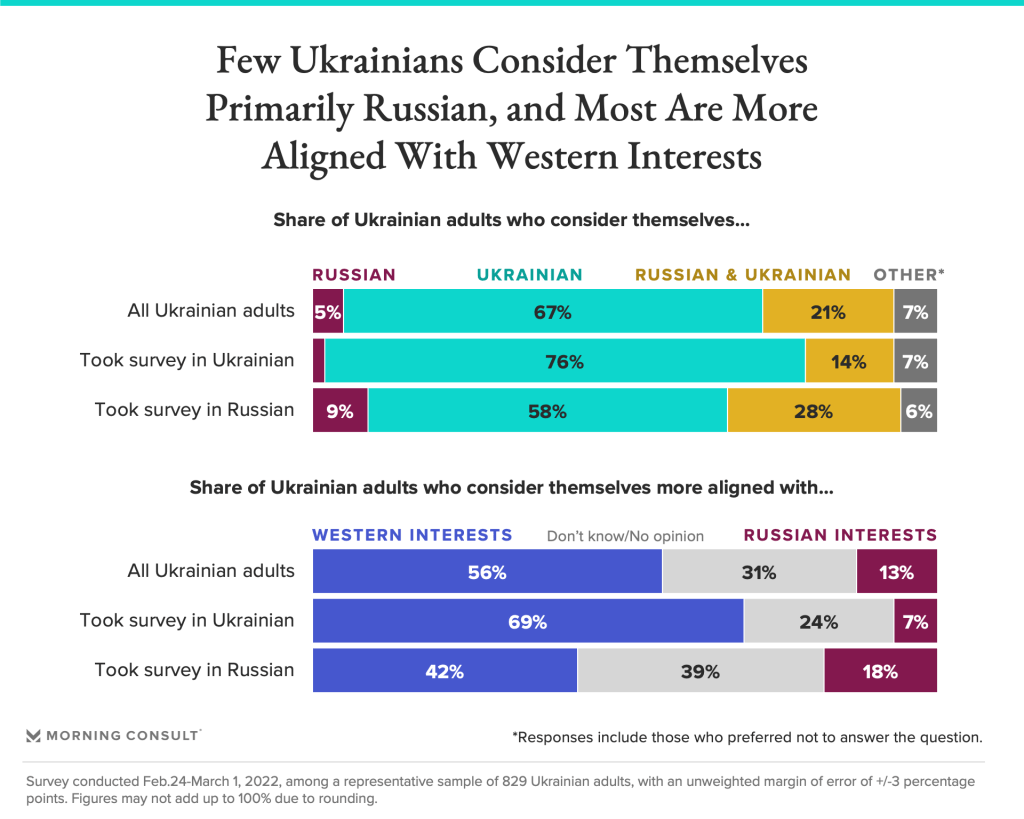
Survey showing how Ukrainian do not recognize themselves as Russian and align their interests with the Western ones (survey by Morning Consult)
He was able to portray this political debate in a dimension of the relationship aggressor state-victim state. In that way, the Western world would have seen the conflict not as an internal philosophical struggle inside the international communist movement, but as aggression for disobedience. Remaining in line, the key pattern of both conflicts is the external vocation the resistance tried to spread in the international scene. Obviously, the military and institutional elites are recurring to ONU, NATO, EU, and other statual and non-statual actors to gain funds, equipment, and resources cheaply. Nevertheless, the wider we go, the more we see how the 1956 Hungarians and 2022 Ukrainians aim for the western free world. They see our democracies as the final stage they wish for their nation, where individuals can make their own choices and freedom is the highway. In fact, Nagy tried to reopen communication channels and trade with Europe, while NATO and EU are discussing the admission of Ukraine. Unfortunately, Budapest’s heroes were smashed by the Red Army and could not benefit from Western support, like Ukraine is doing, as the Cold War was in its hottest momentum and a clear intervention in the enemy’s consolidated sphere would have been an explicit war declaration. However, many countries have already been capable of shifting their position toward the Western world: Poland has never rejected its traditional Christian values and it’s an effective member of NATO and EU net of many social discussable stances, while Baltic countries such as Estonia are pioneers of economical and individual freedom.
Not only. we can say that the western world is like a guy which always portrays himself as unperfect, thinking he will never reach the perfect beauty standards, but he doesn’t notice he’s the most coveted at all: many times, we criticize our system to be unjust and wrong, while all over the world freedom-seekers look at us, with the desire to become like us or more simply to catch our attention and get our help. The single idea that people with different cultures seek western values as their main principle is a huge prize, the same the braves who fought in that cold Hungarian fall deserved.
https://www.britannica.com/event/Hungarian-Revolution-1956
https://www.bbc.com/news/world-europe-26468720
https://morningconsult.com/2022/03/01/ukrainian-survey-nato-support-russian-invasion/
Front page photo by Pinterest


 The Bear Street Journal.
Leave a comment