
- Italy and France are similar in a lot of aspects, except for their energy mix
- The contribution of the 19 nuclear plants managed by EDF to France has been huge, allowing the country to become a net exporter of energy
- Is nuclear power the right path towards a sustainable transition?
On the last 25th of September, Italians voted for the new Parliament and, indirectly, for the new Government since the one in charge, led by Mario Draghi, lost its trust bond, going into crisis. Within the various political parties’ programs, a lot of interest has been put into energy. In fact, it’s safe to say that even before the outbreak of war in Ukraine, Italy had a serious problem: its primary energy sources were non-renewable and imported. This is still the case, and the effects on the economy maybe have been the ultimate reason for the political crisis. A solution to this problem may be nuclear energy, which seems to be an effective, renewable, source of energy. Although during political campaigns a lot of things are mentioned, how could nuclear power change the overview of the Italian energy market? Which companies would emerge? What would be the effects on the population?
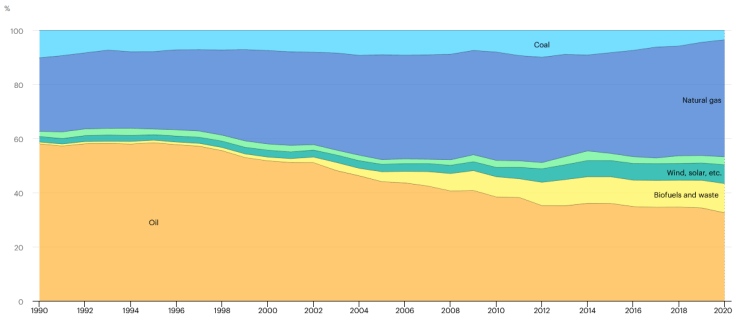
To answer those questions, it’s useful to dive into some data. For reference, the Italian energy market is being compared with France since they are both EU countries and France is already a nuclear power producer. According to Enerdata, in 2021 Italy relied 75% on fossil gas and oil, while only 18% of the total primary energy supply came from renewable sources. Eurostat quantifies the share of energy from renewable sources to be just above 20% in 2020, growing from 12.8% in 2011. As Italy is the fourth EU state in energy at disposal with around 144,034 thousand tons of oil equivalent (ktep), its green energy share is still lower than the EU average of just above 22% and lower than the Euro-adopters states average, standing at 20.9%, but that’s not all: in the latest Eurostat data, Italy is the third worst country in green energy share in EU, only better than Germany and North Macedonia. Furthermore, the ratio between energy produced and energy at disposal is low considering that in 2021, of the 153,000 ktep demand, 36,402 ktep were produced, 143,863 ktep were imported and 29,263 ktep were exported. The ratio of import/export is 4.9, which is quite high. The main partners for import are Russia, Algeria, and the Middle East, while the exports are to northern and central Europe, mainly regarding natural gas. Looking further into the proper energy market, we can notice how it’s quite fragmented and that the market leader is Enel, followed by Eni and Edison, respectively with 17%, 9.1% and 7.6% of market share (2019 data).
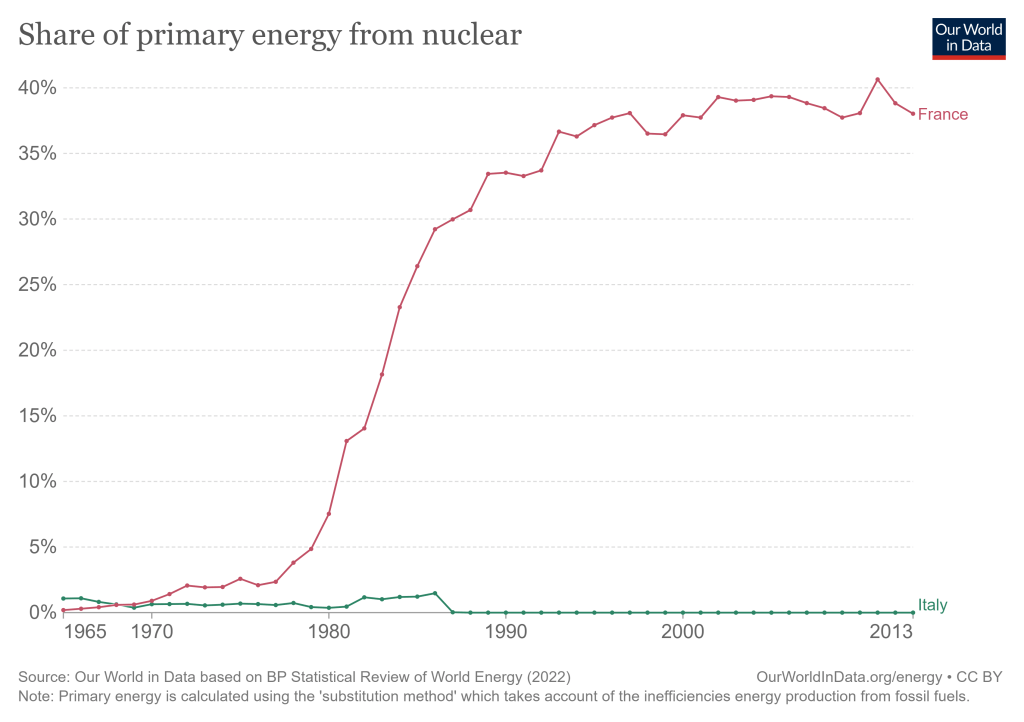
Let’s now look at France. In 2020 France was the second most-consuming EU country, with around 523 TWh (terawatt per hour) * consumed. Of those, 46.79% came from oil and gas, and 13.53% from renewable sources, but the real differentiation factor is nuclear energy: the combined 19 nuclear plants impact in that year was of 36,24%. The production of energy amount in 2020 was around 500 TWh of which 335.4 TWh was from nuclear power and the rest was divided into hydropower, thermal and wind. In the same year, 77.8 TWh of energy was exported and 34.6 TWh of energy was imported. As of 2021, the electric utility company Electricite de France SA (EDF) was the leading utility company in France based on revenue, with a total revenue of nearly 74 billion euros. Engie SA, a multi-utilities company, ranked second then, with a total revenue of nearly 60 billion euros. EDF (largely owned by the French government) controls and operates all the nuclear sites collaborating with Bouygues Construction, Framatome and two subsidiaries of Areva. The ratio of imported energy to exported energy is 0.44.

Based on the data, France and Italy are quite the opposite since France is a net exporter of energy and Italy must rely on its energy partners to satisfy its demand. Certainly, nuclear power is a factor that in France is the result of a long tradition that starts from the first studies and discoveries ever on radioactivity back at the end of the XIX century by Becquerel and Pierre and Marie Curie. The first nuclear power plant by EDF in France was opened in 1962, and as a direct result of the 1973 oil crisis, Prime Minister Pierre Messmer announced what became known as the ‘Messmer Plan’, a huge nuclear power program aimed at generating all of France’s electricity from nuclear power. The plan resulted to be overambitious, as by the mid-’80s the economic value of the facilities was not aligned with the actual demand for energy, resulting in partial usage. As of today, the costs of operation, including waste management and decommissioning, are an important cost, in addition to being one of the side effects of nuclear plants. In Italy, the first plant was opened in 1963 and because of increasing concerns regarding safety, especially after the Three Mile Island incident in 1979 and the Chernobyl incident in 1986, a referendum was invoked in 1987. The results, among others, showed that Italians were averse to state subsidies toward nuclear sites and progressively decreased interest in this form of energy.
Not even mentioning the political difficulties to approve a nuclear plan, it seems that Italy is far from the finish line. And even in the best scenario that everything will follow through smoothly, would it increase efficiency and overall welfare? The answer to this question is difficult to give, considering that the primary source of nuclear power is uranium and that uranium is not present in Italy. This will likely push a different dependence (on other states) on imported sources to be processed and used, as well as the need to develop high-tech plants for uranium enrichment. Other important aspects are the high amount of water used during the thermal transformation as well as the huge cost of security equipment and military reinforcement. Is it possible that maybe nuclear energy is just a way to get around the problem of green transition?
*Please note that TWh is the standard measure for energy production, based on the watt; the conversion to ktep (thousand tons of oil equivalent) is different from the source of energy, for example in Italy one ton of wood coal is 0.74 tep, while one ton of natural gas equals to 0.83 tep.
RESOURCES:
“LA SITUAZIONE ENERGETICA NAZIONALE NEL 2021” by MINISTERO DELLA TRANSIZIONE ECOLOGICA (ITALIAN GOV)– DGIS, July 2022
Statista:
- https://www.statista.com/statistics/873552/energy-mix-in-italy/
- https://www.statista.com/statistics/804019/market-share-of-the-main-household-electricity-providers-in-italy/
- https://0-www-statista-com.lib.unibocconi.it/statistics/1263405/french-electricity-production/
- https://0-www-statista-com.lib.unibocconi.it/statistics/1263840/french-electricity-trade/
- https://0-www-statista-com.lib.unibocconi.it/statistics/1278893/france-utility-companies-revenue-ranking/
Our world in data:
- https://ourworldindata.org/energy/country/italy
- https://ourworldindata.org/energy/country/france#how-much-of-the-country-s-energy-comes-from-low-carbon-sources
Eurostat:
- https://appsso.eurostat.ec.europa.eu/nui/submitViewTableAction.do “Renewable share”
- https://appsso.eurostat.ec.europa.eu/nui/submitViewTableAction.do “Total energy supply”
Other:
- https://greenreport.it/news/energia/la-germania-non-tornera-al-nucleare-per-risparmiare-gas/
- https://www.cleanenergywire.org/factsheets/germanys-energy-consumption-and-power-mix-charts
- https://www.money.it/italia-non-riceve-gas-dalla-russia-ma-lo-esporta-ecco-perche
- https://www.gazzettaufficiale.it/do/atto/serie_generale/caricaPdf?cdimg=14A0273400100010110001&dgu=2014-04-07&art.dataPubblicazioneGazzetta=2014-04-07&art.codiceRedazionale=14A02734&art.num=1&art.tiposerie=SG
- https://www.metallirari.com/10-grandi-paesi-produttori-uranio/
- https://www.ecoage.it/arricchimento-dell-uranio.htm

 The Bear Street Journal.
Leave a comment