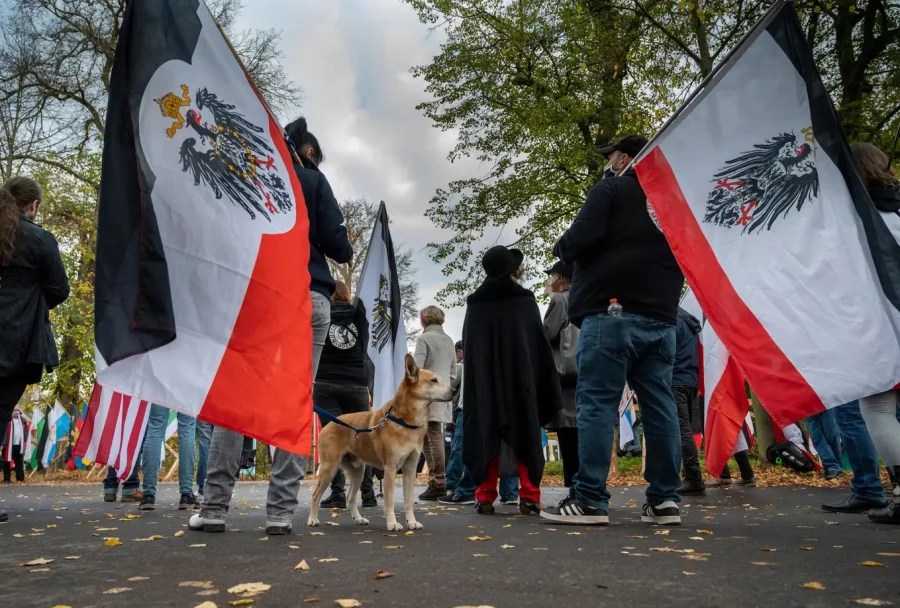
- German Police have arrested in a raid 22 people, accused of plotting a coup against the BRD.
- Many of them are part of a movement, Reichsburger, which wants to restore the monarchy in Germany.
- It’s only one among the several cases of reformer groups, sometimes related to major parties.
Germany seems to be the land of nostalgic movement. The country, where several cases of violence were perpetrated by neo-Nazis, radical left-wing and fanatic Muslims, has now re-discovered the existence of the monarchist fringe. On 7th December German Police officers started a raid in 130 cities, arresting 22 people. They are accused of terrorism and attempted coups.
Among the ones under arrest, there’s Heinrich XIII Prinz Reuss. He comes from a Juncker family, a dynastic landlord family of the Prussian kingdom and the Second German Reich. The family lost all privileges as after 1919 when the Empire was suppressed, but the Reuss family still exists in Austria, where the relatives took distance from Prinz Reuss, as they saw his ideas as extremist and non-sense. According to police reports Reuss and the others under arrest were part of an extremist fringe that was driven by “fantasies and conspirative theories” and their final goal was the destitution of the Republic and the restoration of a monarchist autocracy, with a particular admiration for the Second Reich, the state which ruled over actual Germany from 1871 to 1919. This movement is called “Reichsburgern” (Empire’s citizens), whose approach toward the federal German government is similar to that of the Sovereign Citizens’ Movement against the US government. Moreover, a judge in Berlin seems to be related to this movement. Her name is Birgit Malsack Winkemann, a former right-populist Alternative fur Deutschland MP.
This occurrence, both bizarre both serious, may re-open a discussion about a republican transition process that occurred in the late 19th and 20th centuries. For example, France, which is a Republic since 1871, has its own “nostalgics”. Action Française is the loyalist party, which has existed since 1899 and was created by the journalist and writer Charles Maurras. He wanted the Orleans family to retake power, by enforcing its “Maurrasissme”, which supported French colonialism and chauvinism, and corporativism. Maurras was an admirer of Mussolini, but was cold toward Hitler, as he was a germophobe. The actual Centre Royaliste d’Action Française (CRAF), after supporting both right and left-wing nationalist movements, has become part of Marine Le Pen’s National Front, seen as a traditional and nationalist party, even if stored in a republican system. In particular, Le Pen’s niece was spotted in 2016 in an AF manifestation. Every year the CRAF gathers in Paris on the 21st of January to remember the death of Louis XVI, the king who was guillotined during the French Revolution.
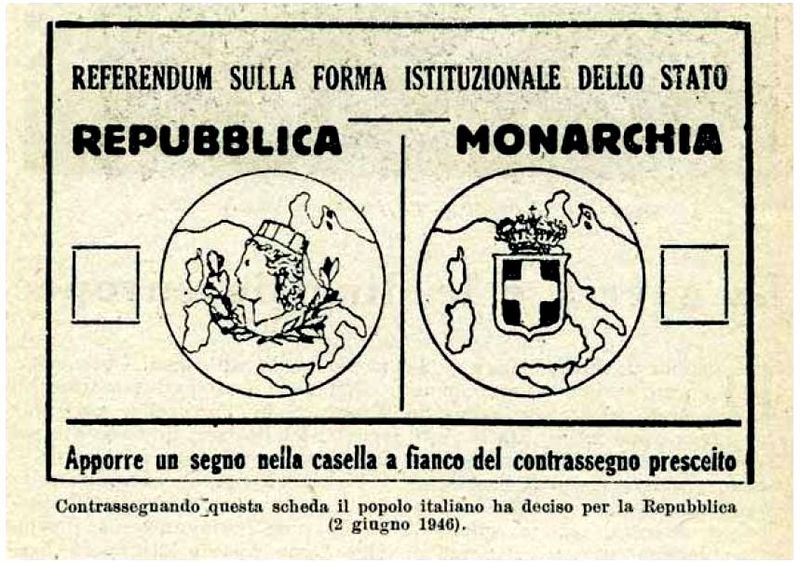
Voting paper of the 1946 republic-monarchy Italian referendum (photo by Wikipedia)
And in Italy? After the 1946 referendum, the many monarchical parties have compared on the scene, even if many other parties had pro-monarchy members (especially inside the Italian Liberal Party and Italian Social Movement) and many influent philosophers, writers, and personalities voted against the republic (Benedetto Croce, Indro Montanelli, Eugenio Scalfari, and Gino Bartali). Actually, an official monarchic party exists: that’s the UMI (Unione Monarchica Italiana), founded in 1944, whose goal is to restore the Savoy-Aosta family to the throne. In many interviews, Alessandro Sacchi, the leader of the formation, said many celebrities visited the party or are party members: honourable mentions are Forza Italia coordinator, Foreign Affairs minister, and former EU Parliament president Antonio Tajani and Vittorio Sgarbi. However, the group doesn’t’ recommend a precise party: members showed a total heterogeneity of political ideas, from lean-left to hard-right.
Many republics in Europe have a political movement that seeks a transition from a republican to a monarchical state, but there’s also the reversed situation: in many kingdoms, there are parties and exponents who openly want the instauration of a republic. That’s the case of the UK: even if data prove the majority of Britons support the monarchy, the death of Queen Elizabeth and the scandals of the Windsor family members could negatively impact the popularity. The real difference with the little monarchical organizations in Germany, France, and Italy, in Great Britain there’s a quite common idea of direct election of the Head of the State, even if it’s not an official position of major parties. Many regional parties minor see the monarchy as the mean of legitimation of England in the Celtic nations, but many members of the Labour and of Liberal-Democrats have released pro-Republic statements. Former Labour leader Jeremy Corbyn revealed he never accepted the rituality and cult of the monarchy and he also didn’t attend Elizabeth II’s funeral (and didn’t communicate his absence). Incredibly, the short-term PM Liz Truss, in her LibDem experience, said she was against the monarchy, but retired her statements as she entered the Conservative Party.

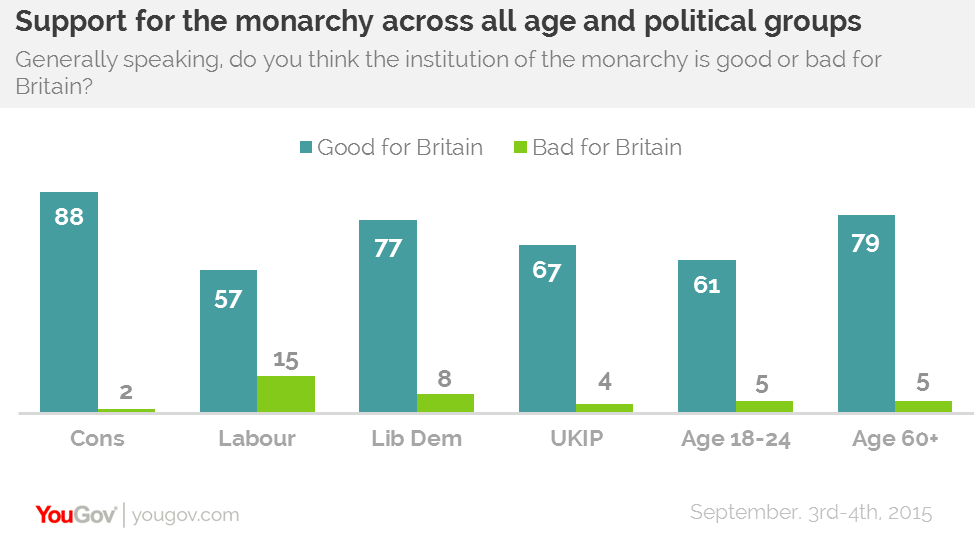
Chart showing 2015 and 2018 YouGov surveys about the monarchy support across sex, ages and political groups.
The hottest situation is in Spain: The country is experiencing an eternal debate between monarchists and republicans. After King Juan Carlos’ Saudi corruption scandals and neutrality accusations against his son Felipe by left-wing parties, the monarchy, according to an ElectoMania.es 2020 survey, for the first time, Spaniards in favour of the republic were majority over Bourbon-Anjou family supporters. In this case, political parties have clear ideas: right-wing parties like Partido Popular and Vox Espana are clearly in favour of monarchy, like the centrist-liberals of Ciudadanos. Radical Left Podemos stated a total refusal of monarchy and their leader Pablo Iglesias accused many time the king to be partisan and to violate the constitution, while centre-left PSOE is living an internal fight, as PM Pedro Sanchez accepts the existence of the monarchy, but it should be reformed, for example, eliminating the immunity for the Royals.
Several confrontations could be made between monarchies and republics about the situations in which one is better than the other, but one thing is clear: precise sympathies are often dictated by previous political ideas, which appropriates many symbols that are also attractive to conservatives and progressists of all Europe and (many cases in Africa and Asia certify it) all over the world.
Front image courtesy of Archive-Bild
Sources:
https://time.com/6239323/germany-raid-coup/
https://www.treccani.it/enciclopedia/charles-maurras/
https://www.actionfrancaise.net/2022/01/31/les-roycos-sont-dans-la-rue/
https://www.focus.it/cultura/storia/2-giugno-1946-i-vip-che-votarono-per-la-monarchia
https://www.politicalite.com/lab/jeremy-corbyn-britain-abolish-monarchy-queen-dies-updated/
https://www.thelocal.es/20220919/explained-what-do-spaniards-think-of-their-royal-family/
https://www.agi.it/estero/news/2020-09-28/spagna-re-podemos-sanchez-scontro-9785090/ https://www.thelocal.es/20211018/the-king-shouldnt-be-untouchable-says-spains-pm/



 The Bear Street Journal.
Leave a comment