
- It is particularly true that most startups have to rely on network effects, which are a result of globalization and technological development.
- The ability to influence the public impacts the customer base, which influences other potential customers in a domino effect.
- The new economy is challenging itself among microeconomics, marketing, epidemiology, business and finance, not to forget computer science.
A network effect is one of the most important aspects to consider when evaluating modern businesses. In fact, as a close consequence of the overall globalization process, the relevance of evaluating externalities can distinguish the strategies and help define objectives. All right, enough with some mediocre introduction, what is the network effect? Basically, network effects arise when the value a customer derives from a good or service grows as other customers adopt compatible products (Katz and Shapiro 1985). In addition, this can happen directly or indirectly (commonly referred to as cross-side or cross-group). In the first case, users of a specific product benefit from the added value provided by the increased number of people using the same; not going too far, this aspect is the underlying driver of the revolutionary industry of social networks. But that’s not it: the user also decides to buy the product -or, in the last example, to sign up for Facebook or LinkedIn- based on how many people already signed up. On the other hand, cross-group network effects occur when at least two different customer groups are interdependent, and the utility of one group increases as the other group grows. To put this idea in financial terms, it is when the listing of a new company increases the utility (and the business) of trading platforms, as they receive more clients that want to buy the new stock. In more immediate examples, Windows benefits from the development of new software, as does Apple with new apps.
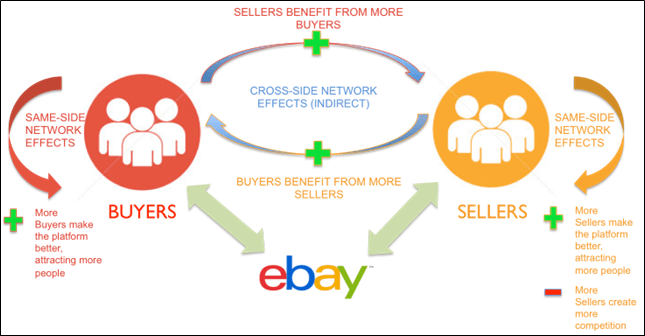
Network effects have been a subject of interest since the middle 80s, ranging from microeconomics, business economics and marketing. In fact, it has been pointed out that, especially in the indirect way, the increase of utility in group A is not linear, but rather follows a hyperbole, because, after a certain amount, the induced indirect utility decreases. It is the case of the already cited software and Windows, where after, let’s say, 200 programs, an additional one does not change the willingness of users to pay for the operating system. This situation occurs in many ‘new economy’ industries (in particular, information and communication technologies), where network effects are pervasive and behave like supply-side economies of scale, in which the quality of an additional unit is decreasing in relation to the number of units produced.
Furthermore, the analysis of network effects can explain, micro-economically speaking, why a certain market is divided between just a few companies. This has been well explained by the idea of “market tipping”, which studies whether the market will eventually be led by just one company, with the others slowly vanishing. As A. Hagiu and D. B. Yoffie pointed out, there needs to be at least 3 elements for the market to tip. The first one is that the value of the network effects must outweigh the benefits of differentiation for users; secondly, users should have higher costs in adopting two or more products rather than one; finally, users must have high switching costs for diverse products. If any of these elements were missing, then multiple compatible products would coexist. For example, Google currently holds 92.21% of the worldwide search engine market share. The reason for it is that the company greatly benefits from a wide range of network effects. In Google’s case, their business increases over every type of news: if a celebrity dies, a lot of people search for him online, while to view the NBA Finals, well, people do the exact same. Meanwhile, it is inconvenient for the public to browse on two separate search engines, as the information stored is different and, sometimes, not even comparable. As for the last element, there is no real cost for the user if he decides to use Yahoo! today, but of course, it would be uncomfortable because he would have to transfer all the saved passwords, plugins, and setups.

Now that is clear why network effects are important, how do they impact the world? Well, the answer would be a lot: social networks, internet companies, and tech start-ups are just a few of them. Generally, wherever the company is based on information services and is organized flexibly. Silicon Valley was indeed founded on network effects and succeeded because it reached and influenced billions of people. Network effects were implemented in network-based strategies and made the fortune of companies like WhatsApp or Twitter. According to HBR, “companies with platform- and network-based business models are exponentially better at creating value”. The intended value is the combination of products and services: the platform is where buyers and sellers meet and connect or, easily, where the nodes are connected. For example, Uber connects drivers and passengers in a platform (their App) but doesn’t create any service out of the blue. This can allow an elastic business model, without high fixed costs if not for a couple of offices. With just around 29,000 employees, Uber Technologies operates in transport, food and package delivery, shipping and others generating over 17 billion $ in revenue across 72 countries and over 10 thousand cities covered by its services (2021 data). It started in 2009 and is one of the best examples of Silicon Valley genius.
From a strategist’s point of view, network effects can be either induced directly or indirectly. The difference between this distinction and the first one made at the beginning is that it underlies the physical act of causing an effect. In fact, a ‘direct’ approach is the way managers can broaden their user base to gain an edge over other companies and add value to the service. For future reference, an ‘indirect’ approach is based on the development of the sides of the value chain, that is to improve the synergies and all the elements that can allow leverage to the main service. For the moment, let’s focus on direct approaches and assume the company we will build the model on is a tech start-up. As was stated, the fundamental element is the user base, which is the number of people who use a particular product or service. The easiest way to increase it is to widen the range and connect the most nodes possible, which means reaching out to the most people. Of course, if there was a way to do this efficiently, there would be no point in writing this article. Unfortunately, there is not, but, since our service can be conveyed as information to the world, maybe a couple of models could help us in understanding how to make our idea spread.
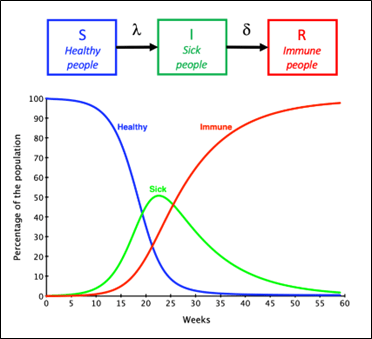
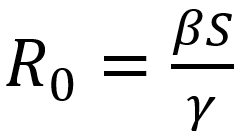
The starting point would be the basic SIR model, which stands for susceptible-infected-recovered as it comes from epidemiology: it is a model that computes the theoretical number of people infected with a contagious illness in a closed population over time. One of the simplest SIR models is the Kermack-McKendrick model: the underlying system of three coupled nonlinear ordinary differential equations is based upon variables t (time), S, I, R, β (infection rate) and γ (recovery rate) and the key value R0 (also called epidemiological threshold). R0 rules the time evolution of the equations and is directly correlated to the infection rate and the susceptible people, and negatively correlated with the recovery rate. Moreover, R0 is different from R (recovered), since it is the number of people infected by contact with a single infected person before his death or recovery, so basically the secondary infections. Simple math suggests that if R0 is minor than 1, the outbreak of the illness will asymptotically reach 0. That is because each person contracting the disease will infect fewer than one person before dying or recovering, so let’s say 1 infects 0.8, then 0.6 and so on. The definition of R0 is the central element in SIR models and can vary in so-called modified SIR models. They tend to apply to the singular case, considering every perk. Especially in academic environments, the spread of information followed a similar pattern to one epidemic. The most relevant limit to this simplification is that people generally transmit a disease involuntarily, while they have the faculty of choosing whether to spread a piece of information or not.
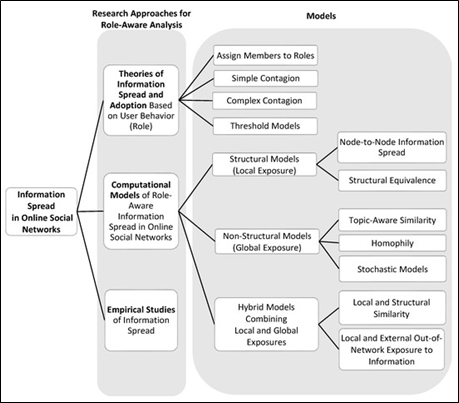
Before the advent of the Internet, radio, television, and newspapers were the main media for transmitting information. Nowadays, traditional media have been gradually replaced by online social networks, which are both a platform for people to engage in social activities and a major channel to obtain information and communicate. Typically, when studying how information spreads in OSNs (online social networks), it is assumed that a User A who follows another User B is more likely to spread information created or shared by User B than users who do not follow. In other words, to encourage diffusion there needs to be what is called a “spreading mechanism”, which is an underlying node-to-node network. In a 2014 study, A. Kramer and other authors found that the emotions of Facebook users that were seen by their friends via the Facebook Wall feature led the exposed friends to express similar emotions, thus influencing those users to spread emotional information online. Following the user-to-user spreading mechanisms, they were found to generate a tree-like structure which relies also on two-step diffusion processes: information first
spreads from the mainstream media to opinion leaders; then, it spreads using a local user-to-user mechanism from opinion leaders to a broader population and creates a tree-like structure. The results were that users are influenced to adopt a behaviour or an innovation depending on the number of their OSN neighbours who were influenced.
To sum up the first article related to the topic, network effects are vital to the first development of start-ups. However, they rarely occur spontaneously. To increase the value of the service directly there needs to be firstly a wide range of people who find out about it and then spread the information on to the secondary users, as the tree-like structure and following the SIR models described. The key moments for inducing a network effect are:
- Identifying the first “susceptible” people
- Understand their willingness to spread information
- Of the interested people, discover how to make them “infected”
- Compare the different options to make them stay “infected”
- Boom! Once all the passages are completed, repeating them will be increasingly easier and cheaper.
RESOURCES
Papers:
- “Network Effects”, by Andrei Hagiu and David B. Yoffie, Harvard Business School, Cambridge, MA, USA, 2016
- “Experimental Evidence of Massive-scale Emotional Contagion Through Social Networks”, by Kramer, A.D.; Guillory, J.E.; Hancock, J.T., USA, 2014
- “Role-Aware Information Spread in Online Social Networks”, by Alon Bartal and Kathleen M. Jagodni, The School of Business Administration, Bar-Ilan University, Ramat Gan 5290002, Israel, 2021
- “A quantitative model for the spread of online information”, by Ping Jiang and Xiangbin Yan, School of Management, Shanghai University of International Business and Economics and Donlinks School of Economics and Management, University of Science and Technology Beijing, Shanghai and Beijing, China, 2019
HBR:
- https://hbr.org/2017/07/you-dont-need-to-be-a-silicon-valley-startup-to-have-a-network-based-strategy
- https://hbr.org/2014/11/what-airbnb-uber-and-alibaba-have-in-common
Others:
https://gs.statcounter.com/search-engine-market-share
https://en.wikipedia.org/wiki/Uber
https://breadcrumb.vc/measuring-network-effects-metrics-in-context-e4c3c98dbf4d




 The Bear Street Journal.
Leave a comment