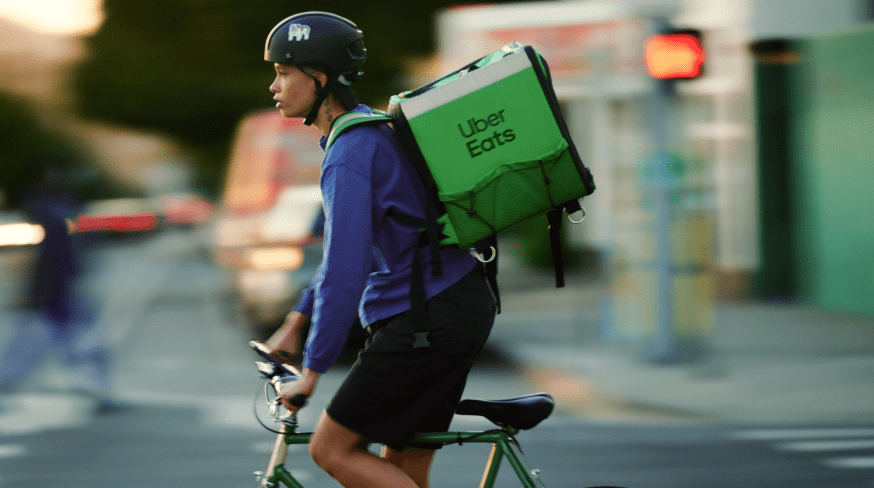
- Food delivery services can benefit from a three-sided network effect, connecting customers, drivers, and restaurants.
- Uber Eats is one of the biggest companies in the food delivery industry and relies on Uber’s technology and customer base.
- As a spinoff, Uber Eats manages to increase the utility of its stakeholders in a very efficient way.
After some time, here we are to make some progress over network effects. The first article introduced the topic and the relevant theories in information spreading and epidemiology. Stated the relevance of having (or inducing) network effects, the focus of this next article is to analyze a case study, explaining the moduli operandi and, finally, discover how did they manage to induce their unique network effect.
Uber Eats is the food delivery service owned by Uber, the ride-share giant founded in 2009 in San Francisco. Its platform was launched in 2014 and generated around USD 8.3 billion in sales in 2021. It is a big player in the online food delivery market, whose size was valued at USD 189.70 billion in 2021 and is expected to expand at a compound annual growth rate (CAGR) of 10.8% from 2022 to 2028. Being extremely linked to the internet and smartphone users, it is an extremely dynamic and expanding sector, especially after the covid-19 pandemic. To further contribute to the market growth there is the rising number of smartphone and internet users globally, who encourage the demand for online food delivery platforms. For that reason, alongside pioneering companies like Uber Eats and Takeaway.com (merged with Just Eat in 2020, but founded in 2000), a whole lot of others, including Doordash Inc. (2013) and Deliveroo (Roofoods Limited, 2013) emerged, forming a competitive and distributed market.
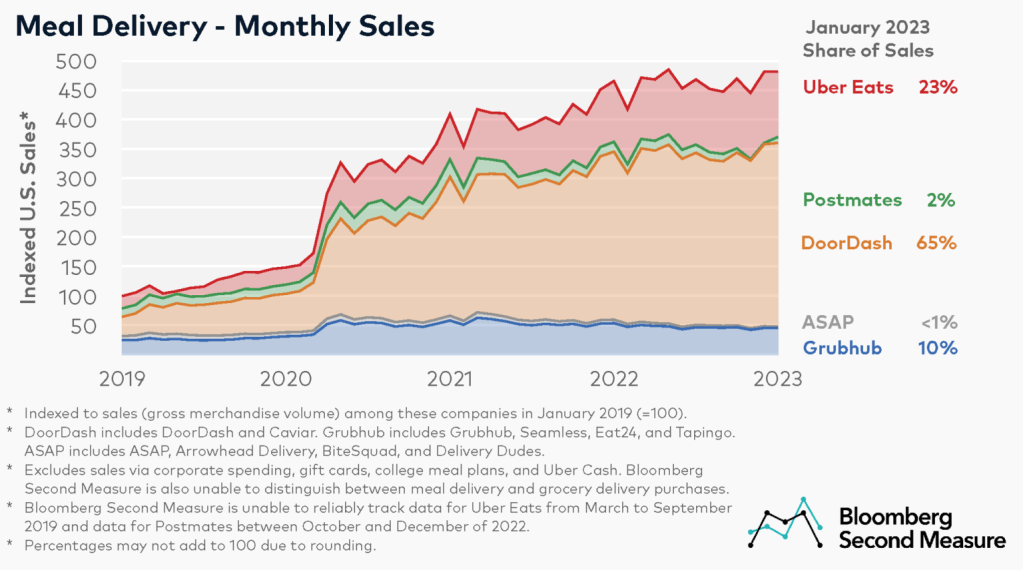
Another peculiarity of food delivery platforms is that they include three main actors, namely the customers, the drivers and the restaurants. To that extent, companies can benefit from an indirect network effect coming from the supply side: in fact, users’ utility is enhanced both from a marginal increase of other users and from a marginal increase in the number of drivers. The reason is that, simply, more drivers can better cover all the areas of a city, both reducing waiting times and increasing customer experience. On one hand, users increase their utility when a vast group of other users already use the application. At the same time, drivers value more the company if there are a lot of consumers available because they can fulfill more orders and earn a higher income. Furthermore, rising consumer demand leads to an increase in the number of restaurants adopting food delivery platforms, because the more consumers use food delivery platforms, the more revenue restaurants can expect from such platforms. Eventually, this will lead to greater adoption of food delivery platforms by local restaurants, also incentivising companies’ investments in technology to make it easier for new users to access these platforms.
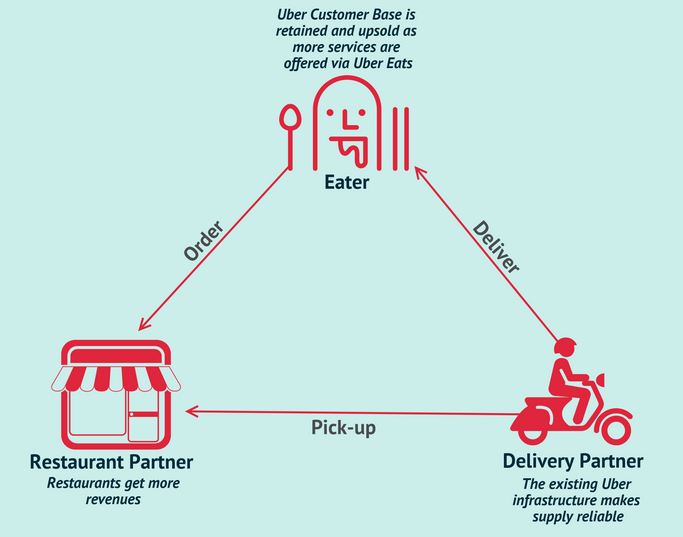
That being said, there are at least three relevant network effects: the first one being users-other users (which is a direct effect, although less important than in social media); the second one being drivers-users (indirect) and the third one being users-drivers-restaurants (also indirect). This virtuous circle generates value both from the supply part and the demand: researchers call it a ‘three-sided network effect’.
In this picture, Uber Eats, relies on a powerful ecosystem specifically designed to integrate everyone and maximise their utility. First of all, new users usually come from the large and valuable Uber customer base, initiated by early advocates in Silicon Valley. In late 2009, Uber started by seeking out early movers and shakers and got them to advocate for the brand, pursuing a hyper-local strategy that changed shape according to the city. To those early adopters, Uber applied a referral marketing program that consisted in giving friends free rides while earning credits themselves. This enabled initial engagement and the development of a loyalty program easily manageable and accessible on a dedicated App (where, for example, users could get special promos or discounts). Furthermore, an innovative system of reviews (both users and drivers could rate each other) pushed the drivers to provide a better service. In addition, Uber concentrated on stunts (very effective for marketing) and partnerships with companies like Capital One or Spotify. Shifting to Uber Eats, users got engaged in a range of algorithms designed by Uber Technologies that neatly organize order management, allocation and dispatch. On top of that, because of the already existing drivers, U.E. is able to offer a no-minimum order policy and quick delivery times, which ultimately increase the value of the service for clients.
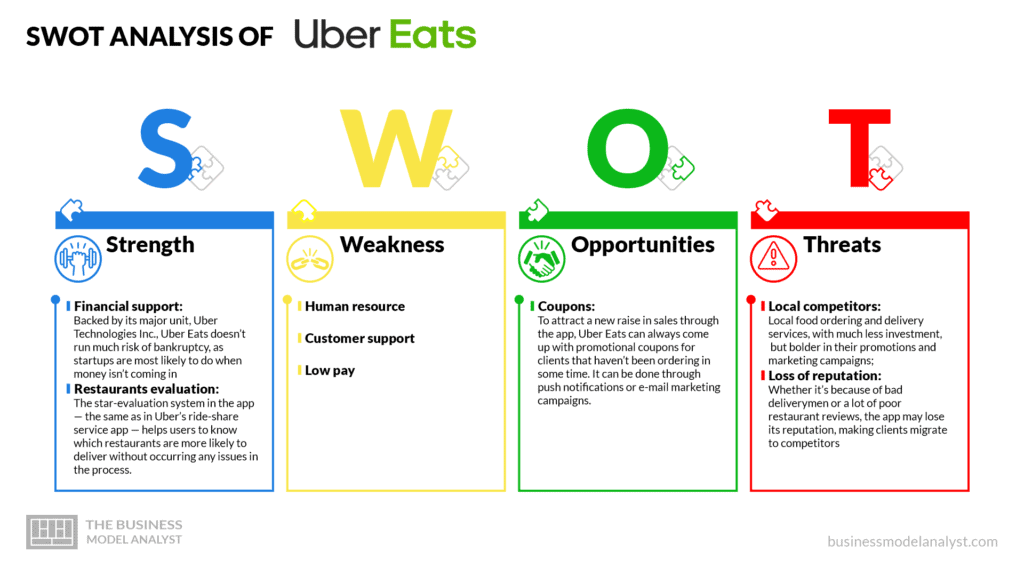
Concerning drivers (widely referred to as ‘riders’), Uber Eats offers to potential candidates easy access to the job: in fact, just a personal mean of transport (bike included) is needed, on top of the age limit. Just upon a quick background scan, riders can get access to a private section of the App on which they are able to select the deliveries and keep track of the earnings. Before accepting any delivery, they can see how much they would earn. In addition, customers have the option to tip in-app, and 100% of tips are theirs to keep. Probably the greatest advantage, the absence of a regular working contract gives the driver an extra flexible approach to the job. In fact, it allows everyone the opportunity to make some money as a great alternative to traditional part-time delivery driver jobs or other part-time employment, temporary jobs, or seasonal work. Of course, earnings range a lot from one city to another (and at different time frames) and generally aren’t excessive, but they tend to be in line with the average salary of a delivery job.
As for the restaurants involved, nowadays they will be likely the ones interested in partnering with Uber Eats (than the other way around), to reach more customers and generate more sales via the community that the service provides. Using a wide customer base, the restaurants (or, in general, merchants) will be able to implement loyalty programs and tailored ads based on the added data generated by the App, from people’s opinions to most selling items. In exchange, Uber Eats earns a 30 % commission (mid-2022 data) on the total cost of orders from partner restaurants, which adds up to the delivery fees (25% on delivery cost) and to the exclusive promotions for restaurants like McDonald’s (which generate extra commissions and fees). Interestingly enough, the initial model for Uber Eats came itself from a restaurant: before the launch of the software, Zalat Pizza, a pizza chain from Dallas (USA) during particularly busy hours, would call up some Uber drivers and try to convince them into delivering their products. As the owner reached over to the company, they then became one of the first partner restaurants.
To sum up, Uber Eats is a well-made spinoff of the Uber model: its key resources are the platform (including both the software, the App and the algorithms), the brand and the restaurant agreements. All of this wouldn’t have been possible without the most valuable asset: the already mentioned three-side network effect. The starting point was Uber’s original customer base, which was largely attracted by subsidies, for example in the form of coupons. Creating the demand, more and more drivers applied and, some years later, it all shifted towards contracts with restaurants. For our research purposes, the most relevant factor is that the initial engagement was made using ‘second generation subsides’, which are basically an additional investment of the startup towards the engagement of an initial niche of early advocates. More on that in the next article coming soon.
SOURCES:
PAPERS
- “Indirect Network Effect and Spillover Effect in Food Delivery Platforms” by Gong Lee, Korea Development Institute, KDI Journal of Economic Policy 2022, South Korea, 2022
Others (last checked 3/3/2023)
- https://www.grandviewresearch.com/industry-analysis/online-food-delivery-market-report
- https://www.annexcloud.com/blog/ubers-marketing-strategy-in-7-steps-revisited/
- https://businessmodelanalyst.com/uber-eats-business-model/#How_Uber_Eats_makes_money
- https://foodondemand.com/06162022/zalat-pizza-and-the-legend-of-ubers-first-restaurant-partner/
- Uber Eats website (https://www.ubereats.com/it)
- https://fourweekmba.com/uber-eats-business-model/
cover image courtesy of: Uber Eats


 The Bear Street Journal.
Leave a comment