
- Greece was the first real test for the European center-right, which it’s trying to compose a new solid majority in Strasbourg
- The result prized the former Prime Minister Kyriakos Mitsotakis and his New Democracy party, which created a “monochromatic” government
- This wide victory can be explained in the renewed trust Greeks put in ND, after life conditions improved decisively since 2019.
2023 will be the final stage before the 2024 European Elections, which seem to be a turning point in continental politics, due to the alliance between the center-right European Popular Party and the right-wing European Conservatives and Reformists, with another key ally, the liberal Renew Europe more than the identitarian right of Identity and Democracy.
Many main countries will vote in next month, like Spain and Poland, and overseas Argentina will hold elections. In Finland, the moderate party Kookomus (EPP in Strasbourg) accepted the alliance with the Perus party (part of ECR).
Even if the EPP-ECR scheme was not respected, the Greek elections showed us how right-wing governments are flourishing all over Europe. On 21st May, Ellenics were called to vote for the new 4 years-government. Prime minister Kyriakos Mitsotakis of New Democracy (center-right, EPP), ruling since 2019 had to face the leader of the radical left Alexis Tsipras, and the moderate left-wing KINAL of Nikos Androulakis. The result of 25th June (after the first turn in May was not enough to elect a new majority) has been clear: New Democracy won the elections by 41%, enough to overcome the 40%-threshold, which guarantees a huge majority prize. According to this rule, ND got 158 out of 300 seats, enough to have a “monochromatic” majority, without any kind of alliance with other parties. Alexis Tsipras’ Syriza lost with only 18% of votes (half of his jubilee in 2015) and elected only 47 deputies, while KINAL was voted by 12% of Greek and got 32 seats.
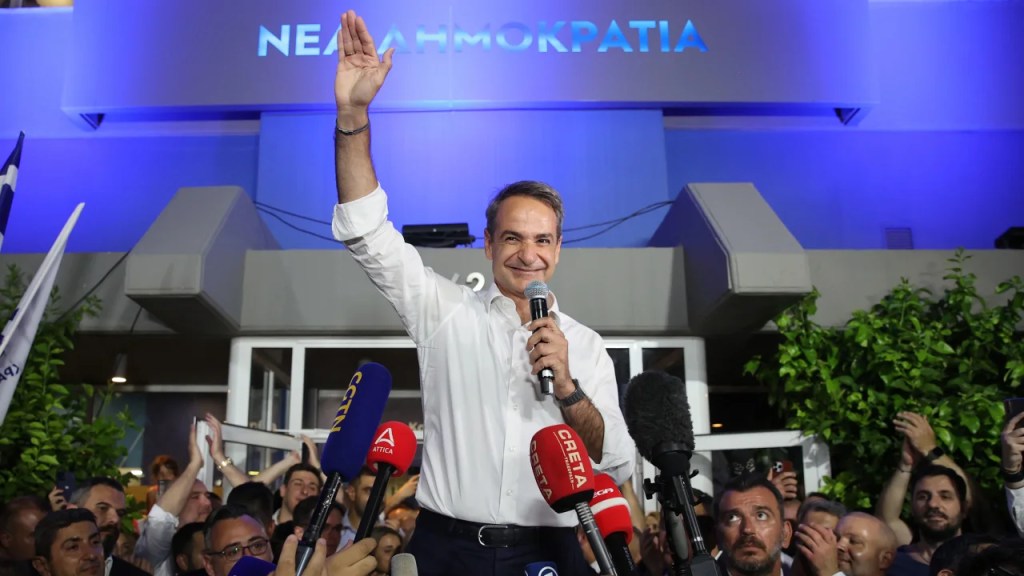
Kyriakos Mitsotakis celebrating the electoral victory in Athens, 2023 (Getty Images)
The 2 historical extremist parties (Communist Greek Party and Golden Dawn, a new-fascist party) got different evolution: the EKK, thanks to the fall of SYRIZA, registered the highest result since 2012 (7,7%), while Golden Dawn, who was the third party between 2014 and 2015, has been declared an illegal association in 2020. The Greek nationalists, who want to restore the “Megali Idea”, the maximal expansion of Greek influence in the eastern Mediterranean, voted for other new extremist parties like the Spartans (who spent the last campaign day under the statue of Leonida, the legendary king of Sparta who stopped the Persian invasion at the Thermopilis) or more moderate exponents (Greek Solution, part of the ECR in Europe).
On 26th June Mitsotakis already had the mandate to create a new government and proclaimed the new cabinet. Out of 24 ministers, 18 are members of New Democracy, while 6 are independents or “technicians”. It seems it’s enough to last till 2027 and that’s a new habit in Greece: from 2004 and 2015 Greece had 8 different governments (both political and transitional), while the second Mitsotakis cabinet is the 4th (3rd, if we don’t the 1-month transition government between May and June 2021) since 2015.
The 41% of ND is not a record in Greek politics; the same New Democracy Party got 45% of votes in the 2004 elections which opened the era of Kostas Karamanlis as Prime Minister, but on that occasion, KINAL settled at 40%, and overall, the 2 main parties (ND and KINAL till 2012, ND and SYRIZA since 2015) have never registered a 10%-gap. In the last elections, the gap was 23%, incredibly wide.
Many experts think the success of ND is due to the new rise of Greece: the years of the “troika”, which led to sharping increase in the cost of life and unemployment and to restrictions imposed in Athens by the European Commission, seem final over. Only the COVID pandemic didn’t allow a full recovery from the 2009-2012 crisis.
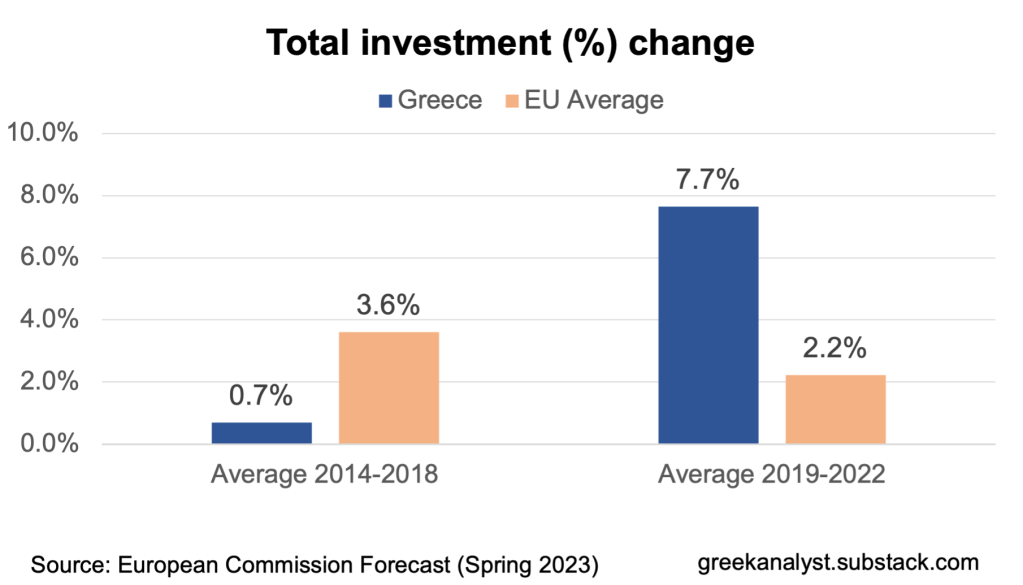
Chart showing the increase of investments between 2014 and 2018, and 2019 and 2022 (EU Commission Forecast datas)
Data from EU Commission and IMF are incredibly positive: from 2019 to 2022 net GDP increased by 1,8% in Greece, while in the EU zone, it stopped at 1,3%. Foreign investments boosted (+7% in the same period). Unemployment is now halved compared to 2014 (15%, against 30% during the period of austerity) and the debt-GDP ratio is 180%. That’s still high, but in 2020 it reached the frightening quote of 215%.
Compared to the European average, many claim it’s a new economic miracle. Experts tend to describe this growth as part of a systematic cycle. Greece is described by Barclays as “interested in a new megacycle”, similar to the ones of the 50s and 70s, when Greece started a rapid growth, after entering the Atlantic Alliance, or in the early 2000s, after joining the European Union. According to the British bank, the rise could be driven by services (now the state can support more this field after the EU declared the end of the state of observance in 2022) and real estate, even if others claim the state must give priority to middle-little enterprises, which, like in Italy, are the majority in the economic outlook.
However, the Greek population has seen with favor the rapid growth of the economy and the more inclusive politics of ND, which earned a full consensus and boosted the growth of right-wing Europe.
The EPP mantains another key member in the Council of Europe (group of leaders of the EU countries) and, in persperctive, ND could give at least 8 MPs at the next European Elections, strenghtening the new possible EPP-ECR majority.
Cover Image fournished by the Italian Council Presidency
Data sources:


 The Bear Street Journal.
Leave a comment