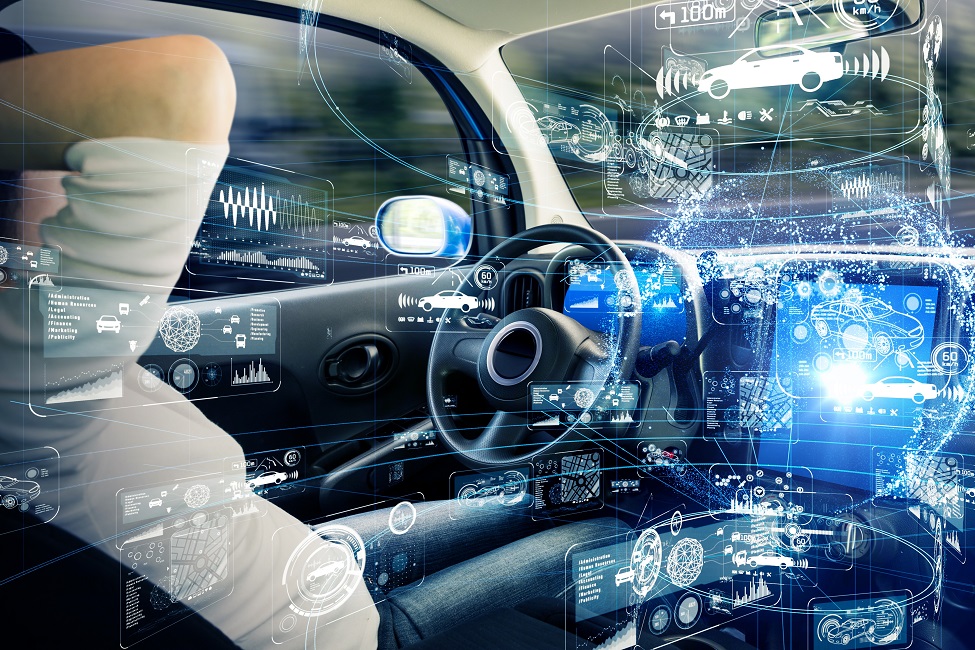
- Machine Learning is a branch of AI focusing on algorithms and models than “auto-learn” from their experience.
- Depending on the learning process, ML algorithms can be either labelled, unlabelled, or reinforced.
- Machine Learning is hidden everywhere, from smartphones to streaming services to the latest self-driving cars.
Over the last article in this series, we embarked on a journey to explain GPT models, which are currently everywhere and arguably one of the most revolutionary technologies in the tech world. If it’s even half true that “90% of Silicon Valley is throwing money at whatever has AI in it” (a friend), then understanding the technology behind it is more than useful. Again, not that there’s need to really convince anybody, but the latest Apple products all feature and heavily communicate on Apple Intelligence, which is essentially a hybrid GPT model. Apple is a tiny tech company whose market cap is around $ 3.4 trillions.
Yet, explaining a Generative Pre-trained Transformer (GPT) model is no easy task. That’s why we started by explaining Natural Language Processing (NLP), the technology enabling computers to understand human language. The next step is understanding Machine Learning (ML), which allows computers to improve their performance on specific tasks through experience, without explicit programming. As defined by Data Camp and Oracle, Machine Learning is a subset of artificial intelligence focusing on developing algorithms and statistical models that enable computers to “auto-learn” through experience. These algorithms are designed to identify patterns, extract insights, and make informed decisions or predictions based on data. Over time, as they process more information, these systems learn and become increasingly accurate and helpful.
Nowadays, ML has found applications across various fields, including natural language processing, computer vision, speech recognition, and predictive analytics in business. As ML algorithms become more powerful in processing larger volumes of data, they also become more sophisticated and versatile. For example, Netflix uses ML algorithms to personalize viewer recommendations, improving customer experience. These recommendations, based on data like viewing history and information about individual shows and movies, are said to drive 80 percent of content streamed on the platform. Using AI for recommendations and service improvement has become a popular practice – almost a must-have – for big tech companies, including Amazon, Spotify, Google, LinkedIn, and many more.
Let’s now understand how ML works, starting from its core element: data. In AI, data is the foundation on which models are built, trained and then operated. Therefore, the quality, quantity, and relevance of data directly impact the performance and accuracy of ML algorithms. Generally speaking, the data used for ML could be either labeled or unlabeled. In the first case, it means that the data has been complemented with informative tags or annotations, providing context or meaning to raw information. For example, in image recognition, labels might indicate whether a photo contains a specific object, while in text analysis, labels could denote sentiment. By doing this, ML models are facilitated in their learning tasks and can perform better. The first type of ML, called “supervised learning” is based on the use of this exact type of labeled data to train the models. In an essential configuration, the algorithm learns to map already classified input data to generate known, already labeled, output information. This type is commonly used for classification and regression tasks.
On the other hand, unsupervised learning works on unlabeled data. In this case, the ML algorithm is free to discover hidden patterns or structures within the dataset without predefined outputs. Less structured and defined data allows for more interpretations and even more “creative” outputs, including patterns not immediately apparent to human observers. This type of ML is widely used in customer segmentation and fraud detection. In retail, companies like Amazon leverage unsupervised learning algorithms to group customers based on their purchasing behaviors, enabling targeted marketing strategies. In the financial sector, banks and financial institutions employ these algorithms to identify anomalous transaction patterns that may indicate fraudulent activity, for instance, in the form of deviations from normal behavior.
Lastly, there’s Reinforcement Learning (RL), a type of machine learning where an agent learns to make decisions by interacting with an environment and receiving rewards or punishments based on its actions. Over time, this allows the model to develop efficient and optimal behavior. This approach of trial and error starts with the model agent having little or no knowledge of the environment, then constantly repeating a loop of act, observe consequence, and receive feedback. One of the most promising real-life use cases of RL is probably the development of autonomous vehicles, particularly self-driving cars. In this case, the agent is the car, which learns optimal behavior through trial-and-error interactions with the environment (the road and others on it). The car receives inputs from sensors and cameras, formulates a “state,” and then learns to take an action (like accelerating or braking) based on that specific state. Of course, for safety reasons, the learning typically starts in a simulated environment, and just after months and tens of millions of interactions, the car is transferred to the real world.
SOURCES
- DataCamp (2024), What is Machine Learning? A Comprehensive Guide. Available at: https://www.datacamp.com/blog/what-is-machine-learning (Accessed: 23 January 2025).
- Oracle (2024), What is Machine Learning? Available at: https://www.oracle.com/artificial-intelligence/machine-learning/what-is-machine-learning/ (Accessed: 23 January 2025).
- New America, Case Study: Netflix. Available at: https://www.newamerica.org/oti/reports/why-am-i-seeing-this/case-study-netflix/ (Accessed: 23 January 2025).
- Akkio, 10 Companies Using Machine Learning in Cool Ways. Available at: https://www.akkio.com/post/10-companies-using-machine-learning-in-cool-ways (Accessed: 23 January 2025).
- Google Cloud Data Labeling Use Cases. Available at: https://cloud.google.com/use-cases/data-labeling (Accessed: 23 January 2025).
- Toloka, Labelled Data vs. Unlabelled Data. Available at: https://toloka.ai/blog/labelled-data-vs-unlabelled-data/ (Accessed: 23 January 2025).
- Forbes, C.,Thesis. Available at: https://users.cs.duke.edu/~forbes/papers/thesis.pdf (Accessed: 23 January 2025).
- arXiv (2023) Reinforcement Learning for Autonomous Driving: A Survey. Available at: https://arxiv.org/abs/2410.22766 (Accessed: 23 January 2025).


 The Bear Street Journal.
Leave a comment